

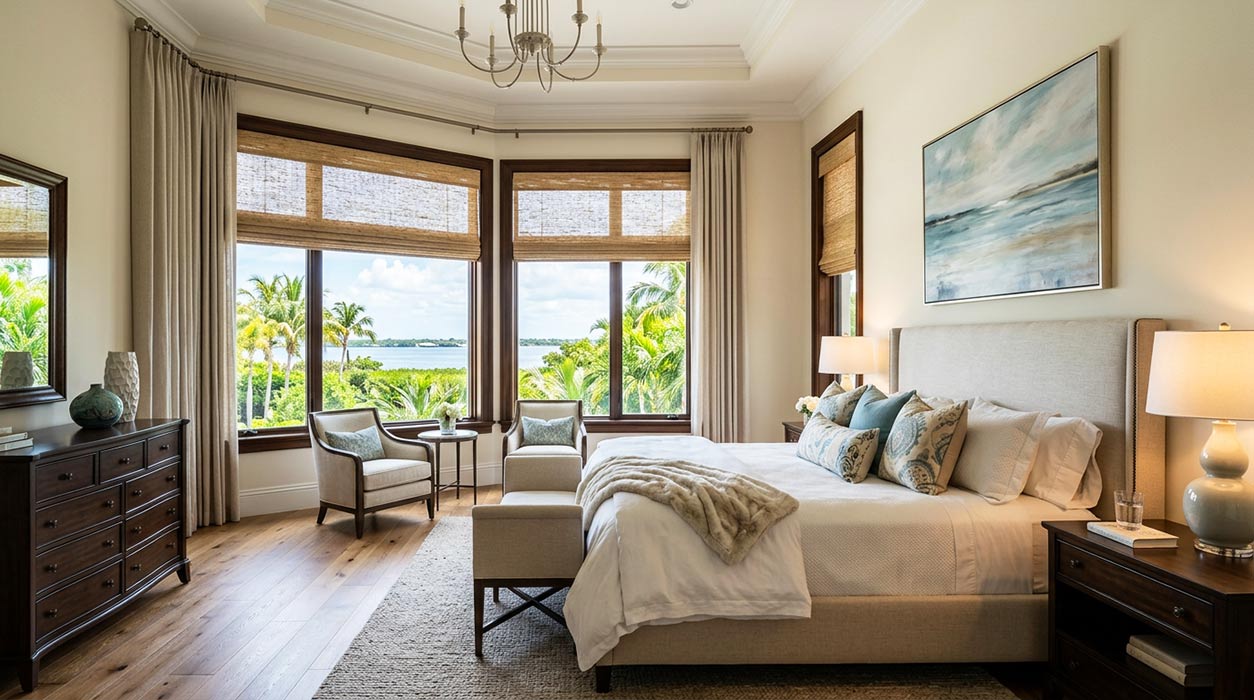
What Are the Best Motorized Window Shades for Jupiter Florida Homes?
Key Takeaways
- The best motorized window shades for smart home integration combine quiet performance, precise automation, design flexibility, and whole-home connectivity.
- Lutron is a leading choice for premium motorized shades, with product families ranging from Serena and Triathlon to Palladiom and Sivoia QS.
- In Jupiter, South and Central Florida, automated shading addresses real challenges: intense sunlight, heat gain, UV exposure, and waterfront privacy.
- Different rooms require different shade strategies; a one-fabric-fits-all approach is one of the most common and costly mistakes.
- Professional installation and programming by a certified Lutron Platinum Dealer ensures shades work as part of a cohesive home automation system, not as a standalone device.
The right motorized shade system does not call attention to itself. The shades move, the room transforms, and the technology disappears entirely into the experience of the home.
For homeowners in South and Central Florida, motorized window shades have become a core element of how a luxury residence functions. The combination of expansive glass, intense sunlight, waterfront views, and elevated design expectations creates conditions where automated shading is a practical and aesthetic necessity.
This guide covers what makes motorized shades genuinely smart-home-ready, why Lutron is consistently a top choice for premium installations, and how the right system should be designed, programmed, and installed for Florida’s specific residential environment.
Quick Answer: What Are the Best Motorized Shades for Smart Homes?
For premium smart home integration, Lutron motorized shades are among the strongest options available, particularly when professionally designed and installed by a certified Lutron dealer.
Lutron’s shading systems are built to work natively with lighting, climate, audio/video, and whole-home automation platforms. They offer a range of product families to match different architectural scales and performance requirements, from the Serena and Triathlon lines for refined residential applications to the Palladiom and Sivoia QS systems for large-format, estate-level installations.
👉 Schedule a VIP consultation to explore the right shading solution for your Florida home.
What Sets Lutron Apart From Shade-Only Solutions:
- Native integration with Lutron lighting control systems, enabling true scene coordination
- Compatibility with Control4, Savant, Crestron, and Josh.ai automation platforms
- Quiet motor performance designed for luxury residential environments
- Precision positioning that allows multiple shades to move in exact synchronization
- A full range of fabric options, from solar screens to full blackout, in architecturally refined finishes
For homeowners in South and Central Florida, Definitive Electronics designs and installs Lutron shading systems as part of fully integrated home automation projects, serving communities from Jupiter and Palm Beach County to Fort Lauderdale, Miami, and Orlando. As a certified Lutron Platinum Dealer, Definitive has achieved the highest level of Lutron certification available, bringing both product access and technical depth that standard dealers cannot match.
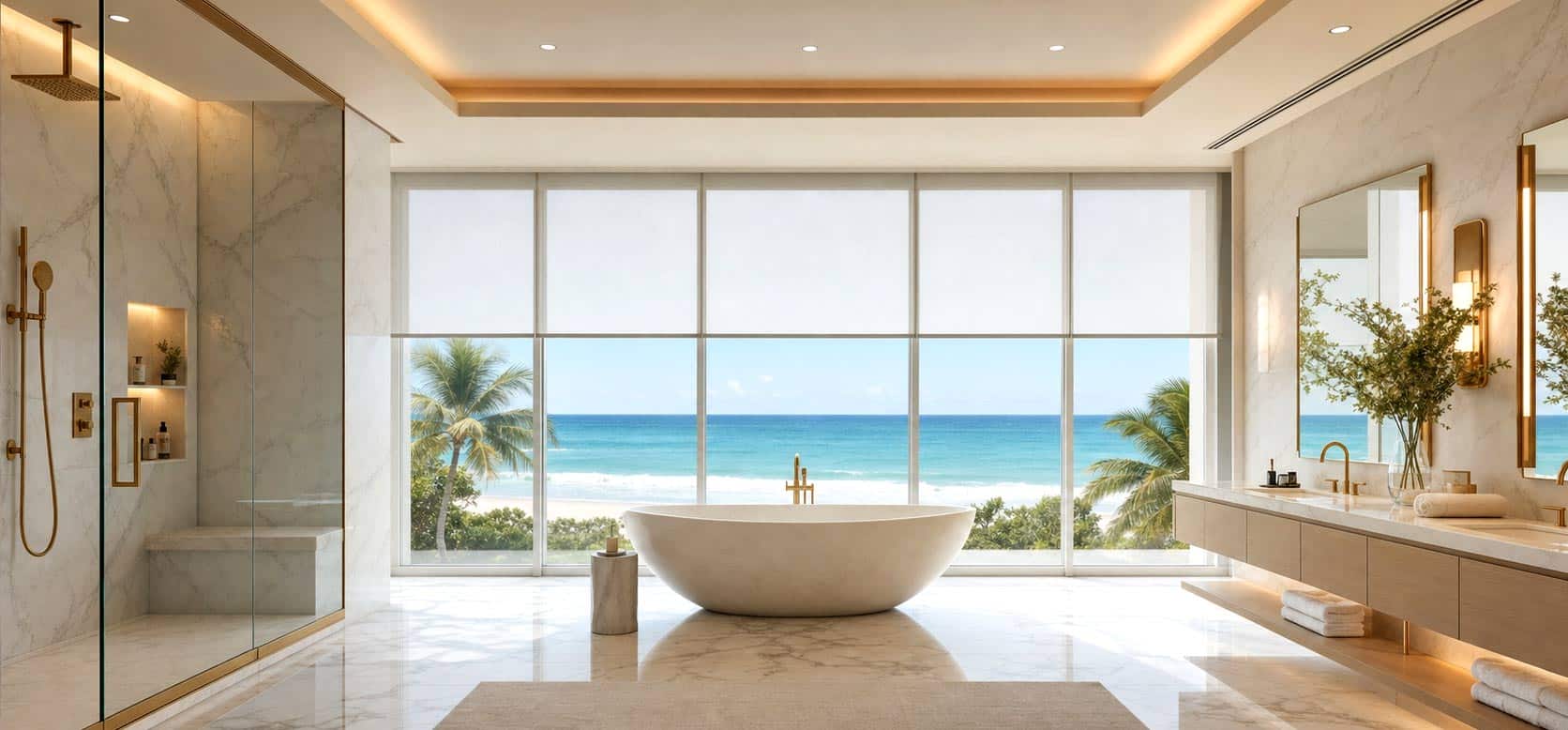
What Makes Motorized Shades Smart Home-Ready?
Not every motorized shade qualifies as a smart home component. A shade that responds only to a dedicated remote or a single proprietary app is a motorized shade. A shade that participates in whole-home scenes, responds to schedules and sensors, and communicates with lighting, climate, and security systems is a smart home shade.
The Five Criteria That Define Smart Home-Ready Motorized Shades:
1. Whole-Home Integration
The shade must communicate with the home’s broader automation ecosystem. This means working within scenes that span multiple systems simultaneously: for example, shades lower while lights adjust, and the thermostat responds to reduced solar load. Systems that operate in isolation require separate control and cannot deliver this level of coordination.
2. Reliable Control Across Multiple Interfaces
A well-designed shading system should respond to any and all control methods the homeowner prefers:
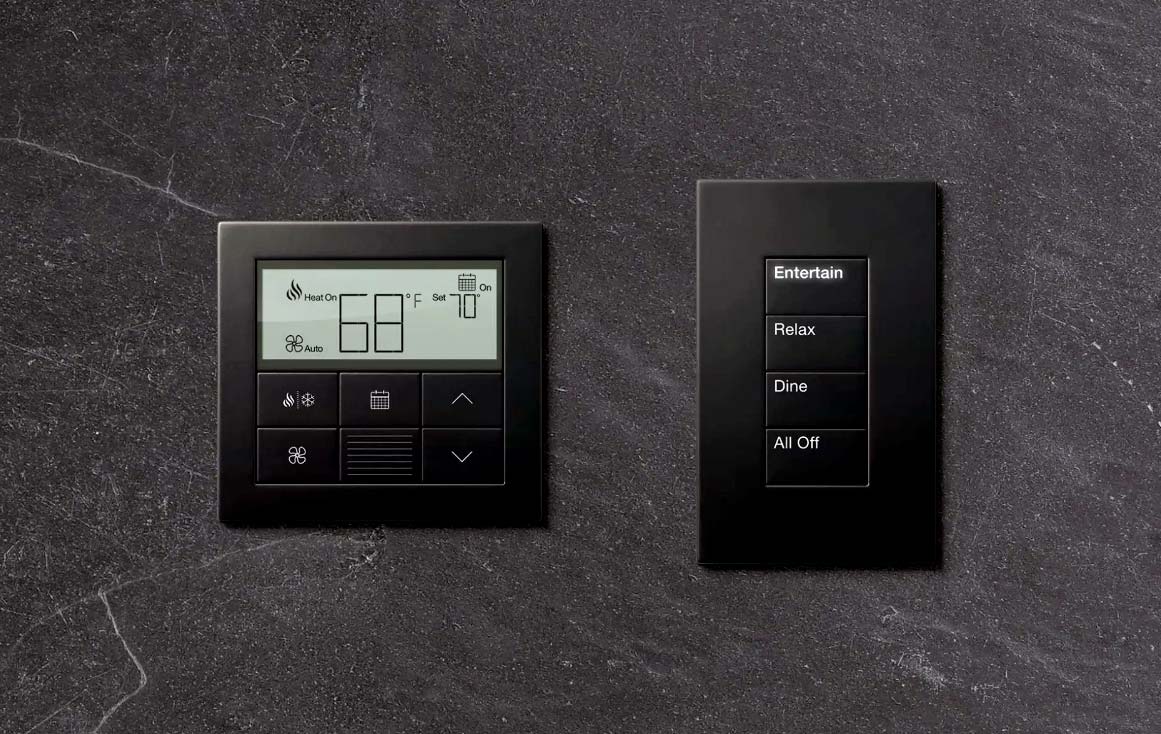
- Keypads: Elegant wall-mounted controls that do not require a phone
- App control: Remote access and scheduling from anywhere
- Voice control: Integration with Josh.ai, Alexa, Google Assistant, or Apple HomeKit where supported
- Automation triggers: Time-of-day schedules, sun position, or occupancy-based responses
Relying on a single control method creates fragility. A luxury home should feel effortless from any interface.
3. Quiet Operation
Motor noise is a non-negotiable consideration in premium residential environments. Shades that produce audible mechanical sound during operation are incompatible with the standard of a well-designed home. Bedrooms, media rooms, and living spaces require motors that move silently and without vibration.
4. Precision and Consistency
In large rooms with multiple windows, shades must stop at identical preset positions and move in perfect synchronization. Inconsistent positioning is immediately visible and signals a system that was not properly programmed or calibrated.
5. Professional Design and Programming
The best shading systems are planned around how the homeowner actually lives in the space. This requires a conversation about daily routines, sun exposure by room, privacy needs, and how the shading system should relate to lighting and entertainment. No off-the-shelf configuration can replicate this.
The best motorized shades are not simply remote-controlled window coverings. They are part of a larger home experience, working with lighting, climate, privacy, and entertainment to make the home more comfortable and easier to live in.
Why Lutron Motorized Shades Are a Top Choice
Lutron has been the global standard in lighting and shading control for over five decades. That longevity is not incidental. It reflects a consistent focus on reliability, quiet performance, and deep integration with the broader home control ecosystem.
For homeowners who want shading to feel like a natural part of the home rather than an add-on product, Lutron’s shading systems offer a level of coherence that shade-only manufacturers cannot replicate. The reason is straightforward: Lutron designs shading and lighting as a unified system. Scenes that coordinate both are not an afterthought. They are built into the architecture of the platform.
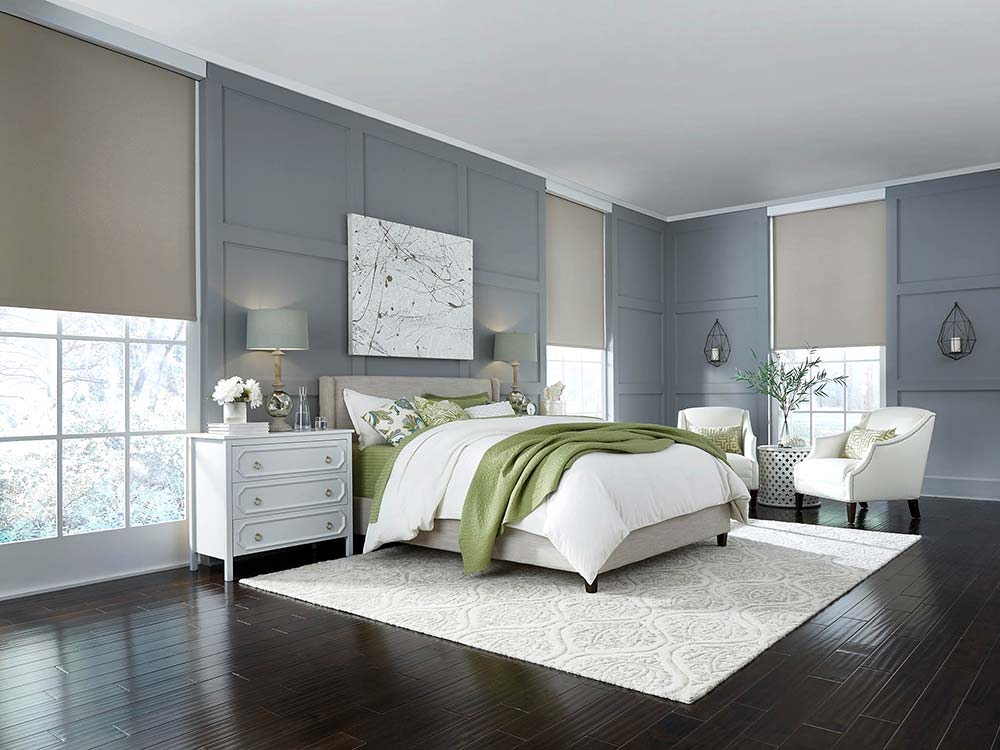
Lutron Shade Product Families
Lutron offers distinct product families designed for different scales and architectural requirements:
| Product Line | Best For |
|---|---|
| Serena | Refined residential applications, wireless convenience, retrofit installations |
| Triathlon | Premium hardwired systems, high-performance motor quality, luxury new construction |
| Palladiom | Estate-level installations, architectural precision, large-format windows |
| Sivoia QS | Whole-home wired shading networks, commercial-grade reliability in residential settings |
Each family supports Lutron’s full range of fabric types, from solar screens and light-filtering materials to full blackout fabrics and drapery systems.
Integration with Lighting and Home Automation
The practical advantage of Lutron shading is its native relationship with Lutron lighting control. A single scene can simultaneously lower shades, adjust lighting to the right color temperature and intensity, and signal other systems to respond. This coordination happens without lag, without workarounds, and without requiring separate programming for each system.
Lutron shading also integrates with the home automation platforms that Definitive Electronics installs and supports: Control4, Savant, Crestron, and Josh.ai. This means shades can be incorporated into whole-home scenes alongside climate, audio/video, and security, all controlled from a single interface through Definitive Electronics’ smart home automation systems.
Design Flexibility
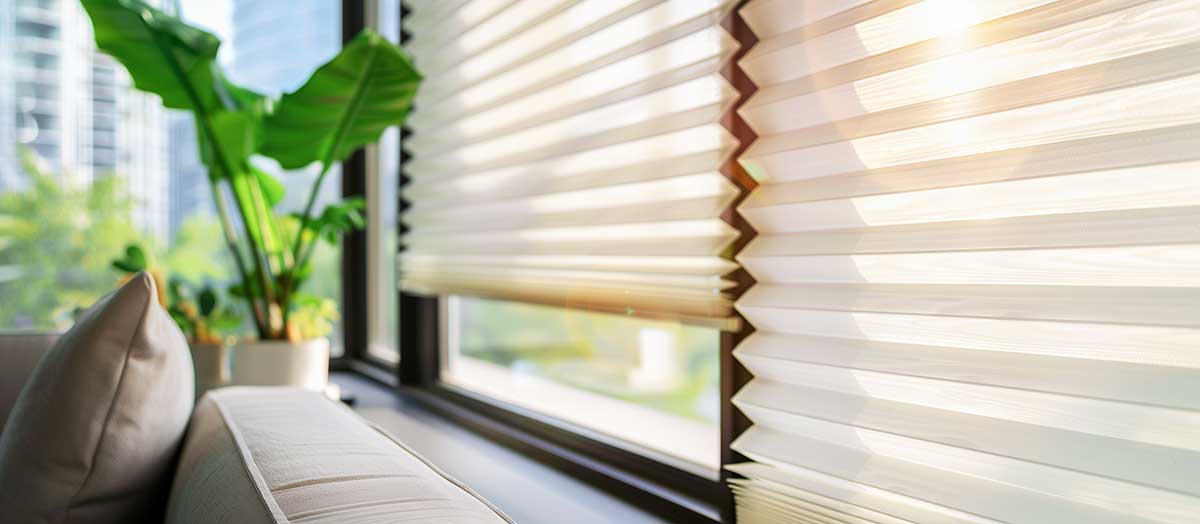
Lutron’s shade systems are available in roller shades, drapery tracks, Roman shades, and specialty configurations for skylight and angled windows. Fabric selections span hundreds of options across openness factors, colors, textures, and performance characteristics. Fascia, shade pockets, and fully concealed installations allow the hardware to disappear into the architecture of the home.
The real advantage: Lutron shading is not a product category. It is a platform. The difference between a Lutron shading system and a collection of motorized shades is the same as the difference between a designed home and a furnished apartment.
Motorized Shade Features That Matter Most in Florida Homes
Generic motorized shades are for generic homes. Florida residences operate under conditions that require a more specific approach.
Managing Intense Sunlight and Heat Gain
Florida’s solar exposure is among the most intense in the continental United States. South- and west-facing windows in Palm Beach County, Jupiter, Boca Raton, Fort Lauderdale, and Miami receive direct sunlight with an intensity and duration that can make rooms uncomfortably warm and visually overwhelming without proper shading.
The practical impact: A room with large west-facing glass and no automated shading during afternoon hours can see interior temperatures rise significantly, placing additional load on HVAC systems and accelerating wear on flooring, furniture, and artwork. Motorized solar screen shades, programmed to deploy during peak sun hours, address this directly.
According to the U.S. Department of Energy, window treatments can reduce heat gain through windows by up to 77%, depending on fabric type and room orientation. In Florida’s climate, this is not an abstract efficiency metric. It translates to measurable comfort and reduced cooling costs.
UV Protection for Luxury Interiors
UV exposure at Florida latitudes is sufficiently intense that fabric selection should account for UV transmission as a material-preservation factor. High-quality solar screen fabrics block a significant portion of UV radiation while maintaining outward views. For homes with custom millwork, fine art, natural stone, and premium flooring, this protection is a meaningful consideration.
Waterfront and Coastal Properties
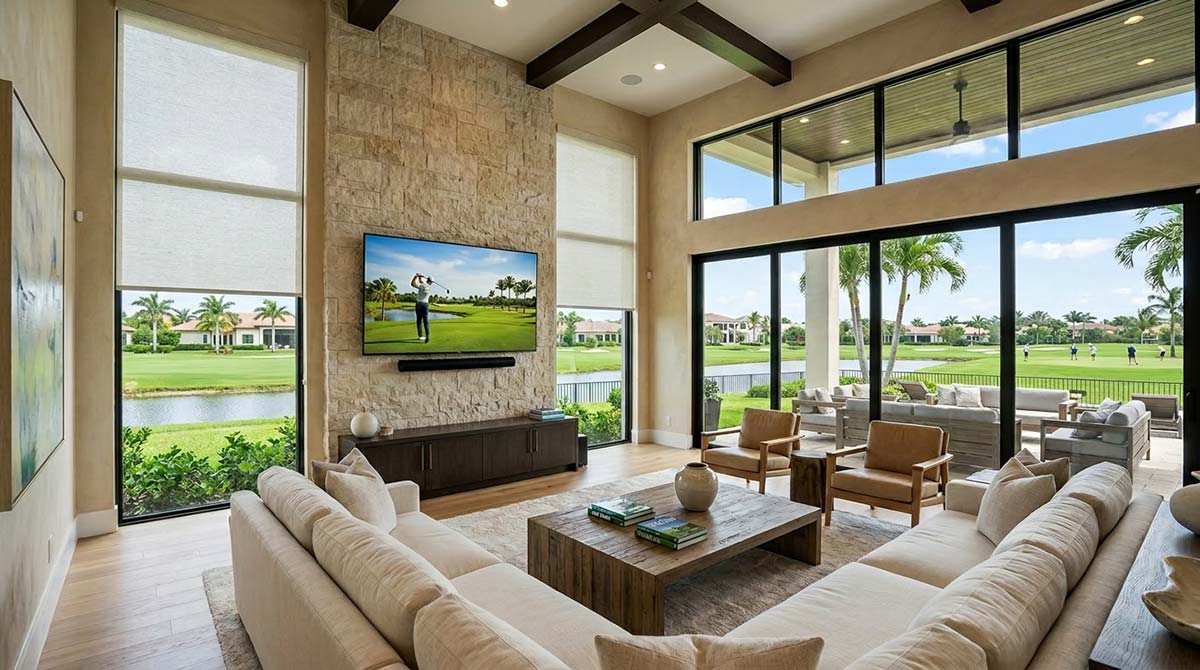
Homes along the Intracoastal Waterway, oceanfront estates on Jupiter Island, and deepwater properties throughout Palm Beach County face a specific challenge: preserving the view while controlling glare and maintaining privacy after dark. Solar screen fabrics with low openness factors accomplish this during daylight hours. Automated schedules that lower privacy shades at sunset handle the evening transition without requiring manual intervention.
Coastal hardware considerations: Salt air and elevated humidity affect finish durability on exposed hardware. Lutron’s Palladiom line, with its solid aluminum and brass bracket options in sealed metal finishes, is specifically suited to coastal residential environments where painted or plated alternatives would deteriorate.
Luxury Home Standards
Florida’s most distinguished residences expect shading systems that are:
- Visually quiet: Concealed headrails, shade pockets, or fully recessed installations
- Acoustically quiet: Motors that operate without audible mechanical sound
- Architecturally integrated: Fabric and finish selections that complement the home’s design language
- Reliably remote-accessible: Essential for homeowners who divide time between properties and need to manage their Florida home from a distance

Room-by-Room Motorized Shade Recommendations
Different rooms require fundamentally different shade strategies. A single fabric specification applied throughout the home is one of the most common and costly mistakes in shading design. The table below outlines the primary shading priorities by room type.
| Room | Recommended Shade Focus |
|---|---|
| Living rooms | Solar screen or light-filtering fabric; glare control while preserving views; scene automation |
| Primary bedrooms | Blackout fabric; quiet motor; privacy scheduling |
| Home theaters | Full blackout; scene integration with display and audio systems |
| Kitchens | Solar screen for heat and glare control; easy scheduling |
| Home offices | Light-filtering or low-openness solar screen to reduce screen glare while maintaining daylight |
| Dining rooms | Light-filtering or privacy fabric; ambiance coordination with lighting scenes |
| Hard-to-reach windows | Motorization is the practical solution; manual operation is not viable |
| Waterfront rooms | Low-openness solar screen; view preservation with glare and UV control |
Home Theater: The Most Demanding Application
A properly designed home theater shading system is not simply a blackout shade on a motor. It is a component of a larger scene. When the “Movie Night” scene activates, blackout shades lower, ambient lighting dims to a preset level, the display or projector powers on, and the audio system prepares to receive input. This happens with a single command.
The shades must be timed correctly within the scene sequence, positioned precisely to eliminate all light intrusion, and programmed to reverse the sequence when the scene ends. This level of coordination requires professional programming, not just product installation. Explore Definitive Electronics’ home theater systems to understand the full scope of what a properly integrated custom home theater entails.
Primary Bedrooms: Blackout and Quiet Above All Else
In a primary bedroom, the two non-negotiable requirements are complete light elimination and silent operation. Blackout fabrics must seal at the sides and bottom of the window to prevent light intrusion. Motors must operate without producing sound that disturbs sleep. Automated morning scenes that gradually raise shades to allow natural light to enter can support a more natural wake cycle, particularly when coordinated with Lutron’s Ketra lighting system, which adjusts color temperature to mirror the quality of morning light.
Wired vs. Wireless Motorized Shades: Which Is Right for Your Home?
The choice between hardwired and wireless motorized shades is primarily a function of where the home is in its construction or renovation lifecycle. Both approaches can deliver excellent smart home integration. The differences lie in long-term maintenance, installation complexity, and scale.
Hardwired Motorized Shades
Hardwired shades draw power directly from the home’s electrical system. This eliminates battery maintenance entirely and is the preferred approach for large-scale installations with many windows.
Best for:
- New construction, where conduit and wiring can be planned before walls are closed
- Major renovations where walls will be opened
- Large homes with 20+ windows requiring motorization
- Installations where long-term reliability and zero battery maintenance are priorities
Wireless and Battery-Powered Motorized Shades
Wireless shades communicate via radio frequency rather than hardwired data connections. Battery-powered motors eliminate the need for electrical runs to each window. This makes wireless shading the practical choice for finished homes where invasive installation is not desirable.
Best for:
- Existing homes without pre-wired shade pockets
- Retrofit installations in finished spaces
- Homeowners who want to add motorization with minimal construction disruption
The trade-off: Battery-powered motors require periodic battery replacement. In a home with many windows, this becomes a maintenance consideration. Lutron’s rechargeable battery systems reduce this burden significantly, but it remains a factor worth planning for.
In new construction or major renovations, hardwired shades are the cleanest long-term solution. For existing homes, wireless or battery-powered systems can deliver the same smart home integration benefits with far less disruption.
A Note on Hybrid Installations
Many Florida homes benefit from a hybrid approach: hardwired shades in rooms where walls are accessible during renovation, and wireless shades in finished spaces where opening walls is not practical. A professional integrator can design a unified system where both types operate within the same scenes and control interfaces, creating a consistent experience regardless of the underlying power method.
Choosing the Right Shade Fabric
Fabric selection is where shading design becomes genuinely custom. The motor and control system determine how the shade operates. The fabric determines what the shade actually does for the room.
Fabric Types and Their Applications
- Solar screen fabrics reduce glare and heat gain while maintaining outward views. Openness factors typically range from 1% to 10%; lower percentages block more light and provide more privacy during daylight hours. The right openness factor depends on the room’s orientation, view priority, and privacy requirements.
- Light-filtering fabrics allow diffused natural light to enter while softening harsh direct sun. They do not provide full privacy at night when interior lights are on. Best suited for living rooms, dining rooms, and spaces where natural light is valued throughout the day.
- Blackout fabrics eliminate light transmission entirely. Essential for primary bedrooms, nurseries, guest suites, and home theaters. Side channels or cassette systems are required to prevent light gaps at the edges.
- Privacy fabrics are designed for rooms where daytime privacy is a priority without blocking natural light entirely. Useful for street-facing rooms, ground-floor spaces, and areas where neighbors or passersby have sightlines into the home.
Design and Finish Considerations
Beyond performance, fabric selection is a design decision. Lutron’s shade systems offer hundreds of fabric options across colors, textures, and weave patterns. Hardware finishes, fascia profiles, and shade pocket designs allow the installation to integrate with the home’s architectural language rather than interrupt it.
The practical rule: Specify fabric by room function first, then refine by design preference. A bedroom that needs blackout shades should not be compromised for aesthetic reasons. A waterfront living room that needs view preservation should not be fitted with a light-filtering fabric that obscures the outlook.
Why Professional Installation and Programming Makes the Difference
The gap between a motorized shade installation and a true smart home shading system is not the product. It is the planning, programming, and integration that go into it.
A professionally designed shading system begins before a single shade is specified. The process includes:
- Site assessment: Sun orientation by room, window dimensions, existing wiring infrastructure, and architectural constraints
- Fabric and product specification: Matching shade families and fabric types to each room’s functional and design requirements
- Power planning: Determining wired vs. wireless configurations and coordinating electrical work during construction or renovation
- Scene design: Mapping out how shades will participate in daily routines, entertainment scenarios, and security schedules
- Integration programming: Connecting the shading system to the home’s automation platform and testing all scene sequences
- Calibration: Setting precise stop positions for every shade and verifying synchronization across multi-window configurations
- Ongoing support: Ensuring the system continues to perform as the home evolves
Programming is where the investment in hardware is either realized or wasted. A Palladiom shade on a motor that stops at inconsistent positions, responds slowly to commands, or operates independently of the home’s other systems is not delivering the value it was designed to provide.
Definitive Electronics’ design-build process covers every stage from initial consultation through installation, programming, and long-term service. This continuity matters for complex systems where the integrator who designed the shading logic is the same team responsible for maintaining it.
Common Mistakes Homeowners Should Avoid
- Choosing shades before planning the control system: The control architecture should be determined first
- Using the same fabric in every room: Performance requirements vary too significantly by room
- Overlooking wiring during construction: The most expensive mistake, and the hardest to correct
- Relying only on app control: Keypads provide more reliable, intuitive daily operation
- Buying DIY motorized shades for a professionally integrated home: These systems cannot participate in whole-home scenes at the required level
- Underestimating large or specialty windows: Oversized windows, skylights, and angled glass require specific product configurations
- Choosing products without local dealer support: Long-term service and programming updates require a local team with product expertise
Why Work with a Certified Lutron Platinum Dealer in Florida?
Lutron’s dealer certification program exists because the quality of a shading system is inseparable from the expertise of the team that designs and installs it. The Platinum level represents the highest tier of Lutron certification, requiring advanced technical training, demonstrated project experience, and ongoing education across Lutron’s full product portfolio.
For homeowners, working with a certified Lutron Platinum dealer means:
- Access to the full product range: Including Palladiom and Sivoia QS systems not available through standard dealers
- Preferred pricing structures: Platinum-level relationships provide access to pricing and design resources unavailable at lower certification tiers
- Technical depth: Certified teams have completed advanced Lutron training, not just basic product familiarity
- Integrated design capability: The ability to design shading as part of a complete lighting and automation system, not as a standalone product category
- Local accountability: A Florida-based team that can respond to service needs, programming updates, and system changes over the life of the home
Definitive Electronics has held Lutron Platinum Dealer status and brings over 25 years of residential integration experience to projects across South and Central Florida. The firm serves homeowners from Orlando to Miami, including luxury enclaves in Jupiter, Palm Beach, Boca Raton, Fort Lauderdale, and the Treasure Coast.
For builders and interior designers working on new construction or major renovations, Definitive Electronics functions as a trusted integration partner: coordinating with the design team on shade pocket specifications, wiring rough-in requirements, and hardware finish selections before walls are closed.
As a certified Lutron Platinum Dealer in Florida, Definitive Electronics designs motorized shading systems that fit the architecture, lifestyle, and home automation ecosystem of the property, not just the window.
The Right Shading System for Your Florida Home
The best motorized window shade system is the one designed for how the home is actually used. That means accounting for solar orientation, room function, privacy requirements, design language, and the home automation platform already in place or being planned.
A quick decision framework:
| Criteria | What to Evaluate |
|---|---|
| Integration | Does the system work within your automation platform (Control4, Savant, Crestron, Josh.ai)? |
| Motor quality | Is the operation genuinely quiet? |
| Fabric options | Are solar, blackout, privacy, and light-filtering options available in suitable finishes? |
| Power method | Is the home in new construction, renovation, or retrofit? |
| Design fit | Can the hardware be concealed within the architecture? |
| Dealer support | Is there a certified local team for programming, service, and long-term support? |
For homeowners in South and Central Florida, the answer to most of these questions points toward Lutron, installed by a certified dealer with the expertise to design the system correctly from the start.
👉 Schedule a private VIP consultation with the Definitive Electronics team to discuss your home’s shading requirements, automation goals, and design priorities. The conversation begins with your home, not a product catalog.
FAQs
What are the best motorized window shades for smart homes?
Lutron motorized shades are among the strongest options for premium smart home integration because they work well with lighting, climate, audio, and whole-home control. Professional design and programming make the system feel coordinated instead of separate.
Are Lutron motorized shades worth it?
Lutron is worth serious consideration for luxury homes because it combines quiet operation, strong reliability, and deep integration with home automation platforms. The result is a shading system that feels refined, responsive, and built for long-term use.
Can motorized shades work with Josh.ai, Alexa, Google Assistant, or Siri?
Yes, many motorized shade systems can work with voice control through compatible smart home platforms. The best setups also support keypads, app control, and scheduled scenes so the shades are easy to use in everyday life.
Do motorized shades help reduce heat in Florida homes?
Yes, motorized shades can help reduce direct sun exposure and manage heat gain, especially on west-facing and waterfront windows. In Florida, that can improve comfort, protect interiors, and support more efficient cooling.
Are wired or wireless motorized shades better?
Wired shades are often the best long-term choice in new construction or major renovations. Wireless or battery-powered shades are often better for finished homes because they reduce disruption during installation.
Should motorized shades be professionally installed?
Yes, professional installation is important because shades must be measured accurately, powered correctly, programmed properly, and integrated into the home’s control system. That is what makes the system reliable and easy to live with.
What is the best motorized shade fabric for glare control?
Solar screen fabrics are the best choice for glare control. They reduce the intensity of direct sunlight while preserving outward views. Lower openness factors block more light and provide better glare reduction, making them well-suited for south- and west-facing rooms in Florida homes.
Can motorized shades be integrated with lighting scenes?
Yes, motorized shades can be programmed to work within the same scenes as lighting, climate, and entertainment systems. A single command can lower the shades, adjust the lights, and prepare the room for how it will be used, all without separate controls.
Why should I choose a Lutron Platinum dealer for motorized shades?
A certified Lutron Platinum dealer has completed the highest level of Lutron training and has access to the full Lutron product range, including estate-level systems not available through standard dealers. They can design shading as part of a complete lighting and automation system, with local support for programming, service, and long-term changes.
Our Growing Florida Service Areas
Definitive Electronics serves homeowners, builders, designers, and architects across many of Florida’s most distinguished communities, from South Florida’s coastline to Central Florida and the Gulf Coast, including:
Palm Beach County
Palm Beach, Boca Raton, Delray Beach, Jupiter, Jupiter Island, Manalapan, Wellington, Highland Beach, Palm Beach Gardens, West Palm Beach, and surrounding communities
Martin County
Stuart, Hobe Sound, Palm City, Sewall’s Point, Hutchinson Island, and nearby waterfront and golf communities
Broward County
Fort Lauderdale, Lighthouse Point, Weston, Coral Springs, Parkland, and coastal and nearby neighborhoods
Miami-Dade County
Miami, Miami Beach, Coral Gables, Key Biscayne, Bal Harbour, Aventura, Coconut Grove, and surrounding communities
Indian River County
Indian River Shores, Orchid, Sebastian, Vero Beach, Wabasso, Windsor
Orange County
Orlando, Windermere, Lake Nona, Winter Park, Isleworth, Keene’s Pointe, Golden Oak, and other Central Florida communities
Tampa Bay Area (Hillsborough and Pinellas Counties)
Tampa, St. Petersburg, Clearwater, Belleair, Palm Harbor, Tierra Verde, and surrounding residential areas
Oceanfront estates, canal properties, private golf communities, luxury condominiums, and new construction projects all benefit from integrated home technology solutions.
Wherever you are within our Florida Service Areas, Definitive Electronics is ready to bring thoughtful design, seamless control, and reliable performance into your space.
Like what you see? Share this post.
Table of Contents
Categories
What Are the Best Motorized Window Shades for Jupiter Florida Homes?
Key Takeaways
- The best motorized window shades for smart home integration combine quiet performance, precise automation, design flexibility, and whole-home connectivity.
- Lutron is a leading choice for premium motorized shades, with product families ranging from Serena and Triathlon to Palladiom and Sivoia QS.
- In Jupiter, South and Central Florida, automated shading addresses real challenges: intense sunlight, heat gain, UV exposure, and waterfront privacy.
- Different rooms require different shade strategies; a one-fabric-fits-all approach is one of the most common and costly mistakes.
- Professional installation and programming by a certified Lutron Platinum Dealer ensures shades work as part of a cohesive home automation system, not as a standalone device.
The right motorized shade system does not call attention to itself. The shades move, the room transforms, and the technology disappears entirely into the experience of the home.
For homeowners in South and Central Florida, motorized window shades have become a core element of how a luxury residence functions. The combination of expansive glass, intense sunlight, waterfront views, and elevated design expectations creates conditions where automated shading is a practical and aesthetic necessity.
This guide covers what makes motorized shades genuinely smart-home-ready, why Lutron is consistently a top choice for premium installations, and how the right system should be designed, programmed, and installed for Florida’s specific residential environment.
Quick Answer: What Are the Best Motorized Shades for Smart Homes?
For premium smart home integration, Lutron motorized shades are among the strongest options available, particularly when professionally designed and installed by a certified Lutron dealer.
Lutron’s shading systems are built to work natively with lighting, climate, audio/video, and whole-home automation platforms. They offer a range of product families to match different architectural scales and performance requirements, from the Serena and Triathlon lines for refined residential applications to the Palladiom and Sivoia QS systems for large-format, estate-level installations.
👉 Schedule a VIP consultation to explore the right shading solution for your Florida home.
What Sets Lutron Apart From Shade-Only Solutions:
- Native integration with Lutron lighting control systems, enabling true scene coordination
- Compatibility with Control4, Savant, Crestron, and Josh.ai automation platforms
- Quiet motor performance designed for luxury residential environments
- Precision positioning that allows multiple shades to move in exact synchronization
- A full range of fabric options, from solar screens to full blackout, in architecturally refined finishes
For homeowners in South and Central Florida, Definitive Electronics designs and installs Lutron shading systems as part of fully integrated home automation projects, serving communities from Jupiter and Palm Beach County to Fort Lauderdale, Miami, and Orlando. As a certified Lutron Platinum Dealer, Definitive has achieved the highest level of Lutron certification available, bringing both product access and technical depth that standard dealers cannot match.
What Makes Motorized Shades Smart Home-Ready?
Not every motorized shade qualifies as a smart home component. A shade that responds only to a dedicated remote or a single proprietary app is a motorized shade. A shade that participates in whole-home scenes, responds to schedules and sensors, and communicates with lighting, climate, and security systems is a smart home shade.
The Five Criteria That Define Smart Home-Ready Motorized Shades:
1. Whole-Home Integration
The shade must communicate with the home’s broader automation ecosystem. This means working within scenes that span multiple systems simultaneously: for example, shades lower while lights adjust, and the thermostat responds to reduced solar load. Systems that operate in isolation require separate control and cannot deliver this level of coordination.
2. Reliable Control Across Multiple Interfaces
A well-designed shading system should respond to any and all control methods the homeowner prefers:
- Keypads: Elegant wall-mounted controls that do not require a phone
- App control: Remote access and scheduling from anywhere
- Voice control: Integration with Josh.ai, Alexa, Google Assistant, or Apple HomeKit where supported
- Automation triggers: Time-of-day schedules, sun position, or occupancy-based responses
Relying on a single control method creates fragility. A luxury home should feel effortless from any interface.
3. Quiet Operation
Motor noise is a non-negotiable consideration in premium residential environments. Shades that produce audible mechanical sound during operation are incompatible with the standard of a well-designed home. Bedrooms, media rooms, and living spaces require motors that move silently and without vibration.
4. Precision and Consistency
In large rooms with multiple windows, shades must stop at identical preset positions and move in perfect synchronization. Inconsistent positioning is immediately visible and signals a system that was not properly programmed or calibrated.
5. Professional Design and Programming
The best shading systems are planned around how the homeowner actually lives in the space. This requires a conversation about daily routines, sun exposure by room, privacy needs, and how the shading system should relate to lighting and entertainment. No off-the-shelf configuration can replicate this.
The best motorized shades are not simply remote-controlled window coverings. They are part of a larger home experience, working with lighting, climate, privacy, and entertainment to make the home more comfortable and easier to live in.
Why Lutron Motorized Shades Are a Top Choice
Lutron has been the global standard in lighting and shading control for over five decades. That longevity is not incidental. It reflects a consistent focus on reliability, quiet performance, and deep integration with the broader home control ecosystem.
For homeowners who want shading to feel like a natural part of the home rather than an add-on product, Lutron’s shading systems offer a level of coherence that shade-only manufacturers cannot replicate. The reason is straightforward: Lutron designs shading and lighting as a unified system. Scenes that coordinate both are not an afterthought. They are built into the architecture of the platform.
Lutron Shade Product Families
Lutron offers distinct product families designed for different scales and architectural requirements:
| Product Line | Best For |
|---|---|
| Serena | Refined residential applications, wireless convenience, retrofit installations |
| Triathlon | Premium hardwired systems, high-performance motor quality, luxury new construction |
| Palladiom | Estate-level installations, architectural precision, large-format windows |
| Sivoia QS | Whole-home wired shading networks, commercial-grade reliability in residential settings |
Each family supports Lutron’s full range of fabric types, from solar screens and light-filtering materials to full blackout fabrics and drapery systems.
Integration with Lighting and Home Automation
The practical advantage of Lutron shading is its native relationship with Lutron lighting control. A single scene can simultaneously lower shades, adjust lighting to the right color temperature and intensity, and signal other systems to respond. This coordination happens without lag, without workarounds, and without requiring separate programming for each system.
Lutron shading also integrates with the home automation platforms that Definitive Electronics installs and supports: Control4, Savant, Crestron, and Josh.ai. This means shades can be incorporated into whole-home scenes alongside climate, audio/video, and security, all controlled from a single interface through Definitive Electronics’ smart home automation systems.
Design Flexibility
Lutron’s shade systems are available in roller shades, drapery tracks, Roman shades, and specialty configurations for skylight and angled windows. Fabric selections span hundreds of options across openness factors, colors, textures, and performance characteristics. Fascia, shade pockets, and fully concealed installations allow the hardware to disappear into the architecture of the home.
The real advantage: Lutron shading is not a product category. It is a platform. The difference between a Lutron shading system and a collection of motorized shades is the same as the difference between a designed home and a furnished apartment.
Motorized Shade Features That Matter Most in Florida Homes
Generic motorized shades are for generic homes. Florida residences operate under conditions that require a more specific approach.
Managing Intense Sunlight and Heat Gain
Florida’s solar exposure is among the most intense in the continental United States. South- and west-facing windows in Palm Beach County, Jupiter, Boca Raton, Fort Lauderdale, and Miami receive direct sunlight with an intensity and duration that can make rooms uncomfortably warm and visually overwhelming without proper shading.
The practical impact: A room with large west-facing glass and no automated shading during afternoon hours can see interior temperatures rise significantly, placing additional load on HVAC systems and accelerating wear on flooring, furniture, and artwork. Motorized solar screen shades, programmed to deploy during peak sun hours, address this directly.
According to the U.S. Department of Energy, window treatments can reduce heat gain through windows by up to 77%, depending on fabric type and room orientation. In Florida’s climate, this is not an abstract efficiency metric. It translates to measurable comfort and reduced cooling costs.
UV Protection for Luxury Interiors
UV exposure at Florida latitudes is sufficiently intense that fabric selection should account for UV transmission as a material-preservation factor. High-quality solar screen fabrics block a significant portion of UV radiation while maintaining outward views. For homes with custom millwork, fine art, natural stone, and premium flooring, this protection is a meaningful consideration.
Waterfront and Coastal Properties
Homes along the Intracoastal Waterway, oceanfront estates on Jupiter Island, and deepwater properties throughout Palm Beach County face a specific challenge: preserving the view while controlling glare and maintaining privacy after dark. Solar screen fabrics with low openness factors accomplish this during daylight hours. Automated schedules that lower privacy shades at sunset handle the evening transition without requiring manual intervention.
Coastal hardware considerations: Salt air and elevated humidity affect finish durability on exposed hardware. Lutron’s Palladiom line, with its solid aluminum and brass bracket options in sealed metal finishes, is specifically suited to coastal residential environments where painted or plated alternatives would deteriorate.
Luxury Home Standards
Florida’s most distinguished residences expect shading systems that are:
- Visually quiet: Concealed headrails, shade pockets, or fully recessed installations
- Acoustically quiet: Motors that operate without audible mechanical sound
- Architecturally integrated: Fabric and finish selections that complement the home’s design language
- Reliably remote-accessible: Essential for homeowners who divide time between properties and need to manage their Florida home from a distance
Room-by-Room Motorized Shade Recommendations
Different rooms require fundamentally different shade strategies. A single fabric specification applied throughout the home is one of the most common and costly mistakes in shading design. The table below outlines the primary shading priorities by room type.
| Room | Recommended Shade Focus |
|---|---|
| Living rooms | Solar screen or light-filtering fabric; glare control while preserving views; scene automation |
| Primary bedrooms | Blackout fabric; quiet motor; privacy scheduling |
| Home theaters | Full blackout; scene integration with display and audio systems |
| Kitchens | Solar screen for heat and glare control; easy scheduling |
| Home offices | Light-filtering or low-openness solar screen to reduce screen glare while maintaining daylight |
| Dining rooms | Light-filtering or privacy fabric; ambiance coordination with lighting scenes |
| Hard-to-reach windows | Motorization is the practical solution; manual operation is not viable |
| Waterfront rooms | Low-openness solar screen; view preservation with glare and UV control |
Home Theater: The Most Demanding Application
A properly designed home theater shading system is not simply a blackout shade on a motor. It is a component of a larger scene. When the “Movie Night” scene activates, blackout shades lower, ambient lighting dims to a preset level, the display or projector powers on, and the audio system prepares to receive input. This happens with a single command.
The shades must be timed correctly within the scene sequence, positioned precisely to eliminate all light intrusion, and programmed to reverse the sequence when the scene ends. This level of coordination requires professional programming, not just product installation. Explore Definitive Electronics’ home theater systems to understand the full scope of what a properly integrated custom home theater entails.
Primary Bedrooms: Blackout and Quiet Above All Else
In a primary bedroom, the two non-negotiable requirements are complete light elimination and silent operation. Blackout fabrics must seal at the sides and bottom of the window to prevent light intrusion. Motors must operate without producing sound that disturbs sleep. Automated morning scenes that gradually raise shades to allow natural light to enter can support a more natural wake cycle, particularly when coordinated with Lutron’s Ketra lighting system, which adjusts color temperature to mirror the quality of morning light.
Wired vs. Wireless Motorized Shades: Which Is Right for Your Home?
The choice between hardwired and wireless motorized shades is primarily a function of where the home is in its construction or renovation lifecycle. Both approaches can deliver excellent smart home integration. The differences lie in long-term maintenance, installation complexity, and scale.
Hardwired Motorized Shades
Hardwired shades draw power directly from the home’s electrical system. This eliminates battery maintenance entirely and is the preferred approach for large-scale installations with many windows.
Best for:
- New construction, where conduit and wiring can be planned before walls are closed
- Major renovations where walls will be opened
- Large homes with 20+ windows requiring motorization
- Installations where long-term reliability and zero battery maintenance are priorities
Wireless and Battery-Powered Motorized Shades
Wireless shades communicate via radio frequency rather than hardwired data connections. Battery-powered motors eliminate the need for electrical runs to each window. This makes wireless shading the practical choice for finished homes where invasive installation is not desirable.
Best for:
- Existing homes without pre-wired shade pockets
- Retrofit installations in finished spaces
- Homeowners who want to add motorization with minimal construction disruption
The trade-off: Battery-powered motors require periodic battery replacement. In a home with many windows, this becomes a maintenance consideration. Lutron’s rechargeable battery systems reduce this burden significantly, but it remains a factor worth planning for.
In new construction or major renovations, hardwired shades are the cleanest long-term solution. For existing homes, wireless or battery-powered systems can deliver the same smart home integration benefits with far less disruption.
A Note on Hybrid Installations
Many Florida homes benefit from a hybrid approach: hardwired shades in rooms where walls are accessible during renovation, and wireless shades in finished spaces where opening walls is not practical. A professional integrator can design a unified system where both types operate within the same scenes and control interfaces, creating a consistent experience regardless of the underlying power method.
Choosing the Right Shade Fabric
Fabric selection is where shading design becomes genuinely custom. The motor and control system determine how the shade operates. The fabric determines what the shade actually does for the room.
Fabric Types and Their Applications
- Solar screen fabrics reduce glare and heat gain while maintaining outward views. Openness factors typically range from 1% to 10%; lower percentages block more light and provide more privacy during daylight hours. The right openness factor depends on the room’s orientation, view priority, and privacy requirements.
- Light-filtering fabrics allow diffused natural light to enter while softening harsh direct sun. They do not provide full privacy at night when interior lights are on. Best suited for living rooms, dining rooms, and spaces where natural light is valued throughout the day.
- Blackout fabrics eliminate light transmission entirely. Essential for primary bedrooms, nurseries, guest suites, and home theaters. Side channels or cassette systems are required to prevent light gaps at the edges.
- Privacy fabrics are designed for rooms where daytime privacy is a priority without blocking natural light entirely. Useful for street-facing rooms, ground-floor spaces, and areas where neighbors or passersby have sightlines into the home.
Design and Finish Considerations
Beyond performance, fabric selection is a design decision. Lutron’s shade systems offer hundreds of fabric options across colors, textures, and weave patterns. Hardware finishes, fascia profiles, and shade pocket designs allow the installation to integrate with the home’s architectural language rather than interrupt it.
The practical rule: Specify fabric by room function first, then refine by design preference. A bedroom that needs blackout shades should not be compromised for aesthetic reasons. A waterfront living room that needs view preservation should not be fitted with a light-filtering fabric that obscures the outlook.
Why Professional Installation and Programming Makes the Difference
The gap between a motorized shade installation and a true smart home shading system is not the product. It is the planning, programming, and integration that go into it.
A professionally designed shading system begins before a single shade is specified. The process includes:
- Site assessment: Sun orientation by room, window dimensions, existing wiring infrastructure, and architectural constraints
- Fabric and product specification: Matching shade families and fabric types to each room’s functional and design requirements
- Power planning: Determining wired vs. wireless configurations and coordinating electrical work during construction or renovation
- Scene design: Mapping out how shades will participate in daily routines, entertainment scenarios, and security schedules
- Integration programming: Connecting the shading system to the home’s automation platform and testing all scene sequences
- Calibration: Setting precise stop positions for every shade and verifying synchronization across multi-window configurations
- Ongoing support: Ensuring the system continues to perform as the home evolves
Programming is where the investment in hardware is either realized or wasted. A Palladiom shade on a motor that stops at inconsistent positions, responds slowly to commands, or operates independently of the home’s other systems is not delivering the value it was designed to provide.
Definitive Electronics’ design-build process covers every stage from initial consultation through installation, programming, and long-term service. This continuity matters for complex systems where the integrator who designed the shading logic is the same team responsible for maintaining it.
Common Mistakes Homeowners Should Avoid
- Choosing shades before planning the control system: The control architecture should be determined first
- Using the same fabric in every room: Performance requirements vary too significantly by room
- Overlooking wiring during construction: The most expensive mistake, and the hardest to correct
- Relying only on app control: Keypads provide more reliable, intuitive daily operation
- Buying DIY motorized shades for a professionally integrated home: These systems cannot participate in whole-home scenes at the required level
- Underestimating large or specialty windows: Oversized windows, skylights, and angled glass require specific product configurations
- Choosing products without local dealer support: Long-term service and programming updates require a local team with product expertise
Why Work with a Certified Lutron Platinum Dealer in Florida?
Lutron’s dealer certification program exists because the quality of a shading system is inseparable from the expertise of the team that designs and installs it. The Platinum level represents the highest tier of Lutron certification, requiring advanced technical training, demonstrated project experience, and ongoing education across Lutron’s full product portfolio.
For homeowners, working with a certified Lutron Platinum dealer means:
- Access to the full product range: Including Palladiom and Sivoia QS systems not available through standard dealers
- Preferred pricing structures: Platinum-level relationships provide access to pricing and design resources unavailable at lower certification tiers
- Technical depth: Certified teams have completed advanced Lutron training, not just basic product familiarity
- Integrated design capability: The ability to design shading as part of a complete lighting and automation system, not as a standalone product category
- Local accountability: A Florida-based team that can respond to service needs, programming updates, and system changes over the life of the home
Definitive Electronics has held Lutron Platinum Dealer status and brings over 25 years of residential integration experience to projects across South and Central Florida. The firm serves homeowners from Orlando to Miami, including luxury enclaves in Jupiter, Palm Beach, Boca Raton, Fort Lauderdale, and the Treasure Coast.
For builders and interior designers working on new construction or major renovations, Definitive Electronics functions as a trusted integration partner: coordinating with the design team on shade pocket specifications, wiring rough-in requirements, and hardware finish selections before walls are closed.
As a certified Lutron Platinum Dealer in Florida, Definitive Electronics designs motorized shading systems that fit the architecture, lifestyle, and home automation ecosystem of the property, not just the window.
The Right Shading System for Your Florida Home
The best motorized window shade system is the one designed for how the home is actually used. That means accounting for solar orientation, room function, privacy requirements, design language, and the home automation platform already in place or being planned.
A quick decision framework:
| Criteria | What to Evaluate |
|---|---|
| Integration | Does the system work within your automation platform (Control4, Savant, Crestron, Josh.ai)? |
| Motor quality | Is the operation genuinely quiet? |
| Fabric options | Are solar, blackout, privacy, and light-filtering options available in suitable finishes? |
| Power method | Is the home in new construction, renovation, or retrofit? |
| Design fit | Can the hardware be concealed within the architecture? |
| Dealer support | Is there a certified local team for programming, service, and long-term support? |
For homeowners in South and Central Florida, the answer to most of these questions points toward Lutron, installed by a certified dealer with the expertise to design the system correctly from the start.
👉 Schedule a private VIP consultation with the Definitive Electronics team to discuss your home’s shading requirements, automation goals, and design priorities. The conversation begins with your home, not a product catalog.
FAQs
What are the best motorized window shades for smart homes?
Lutron motorized shades are among the strongest options for premium smart home integration because they work well with lighting, climate, audio, and whole-home control. Professional design and programming make the system feel coordinated instead of separate.
Are Lutron motorized shades worth it?
Lutron is worth serious consideration for luxury homes because it combines quiet operation, strong reliability, and deep integration with home automation platforms. The result is a shading system that feels refined, responsive, and built for long-term use.
Can motorized shades work with Josh.ai, Alexa, Google Assistant, or Siri?
Yes, many motorized shade systems can work with voice control through compatible smart home platforms. The best setups also support keypads, app control, and scheduled scenes so the shades are easy to use in everyday life.
Do motorized shades help reduce heat in Florida homes?
Yes, motorized shades can help reduce direct sun exposure and manage heat gain, especially on west-facing and waterfront windows. In Florida, that can improve comfort, protect interiors, and support more efficient cooling.
Are wired or wireless motorized shades better?
Wired shades are often the best long-term choice in new construction or major renovations. Wireless or battery-powered shades are often better for finished homes because they reduce disruption during installation.
Should motorized shades be professionally installed?
Yes, professional installation is important because shades must be measured accurately, powered correctly, programmed properly, and integrated into the home’s control system. That is what makes the system reliable and easy to live with.
What is the best motorized shade fabric for glare control?
Solar screen fabrics are the best choice for glare control. They reduce the intensity of direct sunlight while preserving outward views. Lower openness factors block more light and provide better glare reduction, making them well-suited for south- and west-facing rooms in Florida homes.
Can motorized shades be integrated with lighting scenes?
Yes, motorized shades can be programmed to work within the same scenes as lighting, climate, and entertainment systems. A single command can lower the shades, adjust the lights, and prepare the room for how it will be used, all without separate controls.
Why should I choose a Lutron Platinum dealer for motorized shades?
A certified Lutron Platinum dealer has completed the highest level of Lutron training and has access to the full Lutron product range, including estate-level systems not available through standard dealers. They can design shading as part of a complete lighting and automation system, with local support for programming, service, and long-term changes.
Our Growing Florida Service Areas
Definitive Electronics serves homeowners, builders, designers, and architects across many of Florida’s most distinguished communities, from South Florida’s coastline to Central Florida and the Gulf Coast, including:
Palm Beach County
Palm Beach, Boca Raton, Delray Beach, Jupiter, Jupiter Island, Manalapan, Wellington, Highland Beach, Palm Beach Gardens, West Palm Beach, and surrounding communities
Martin County
Stuart, Hobe Sound, Palm City, Sewall’s Point, Hutchinson Island, and nearby waterfront and golf communities
Broward County
Fort Lauderdale, Lighthouse Point, Weston, Coral Springs, Parkland, and coastal and nearby neighborhoods
Miami-Dade County
Miami, Miami Beach, Coral Gables, Key Biscayne, Bal Harbour, Aventura, Coconut Grove, and surrounding communities
Indian River County
Indian River Shores, Orchid, Sebastian, Vero Beach, Wabasso, Windsor
Orange County
Orlando, Windermere, Lake Nona, Winter Park, Isleworth, Keene’s Pointe, Golden Oak, and other Central Florida communities
Tampa Bay Area (Hillsborough and Pinellas Counties)
Tampa, St. Petersburg, Clearwater, Belleair, Palm Harbor, Tierra Verde, and surrounding residential areas
Oceanfront estates, canal properties, private golf communities, luxury condominiums, and new construction projects all benefit from integrated home technology solutions.
Wherever you are within our Florida Service Areas, Definitive Electronics is ready to bring thoughtful design, seamless control, and reliable performance into your space.