


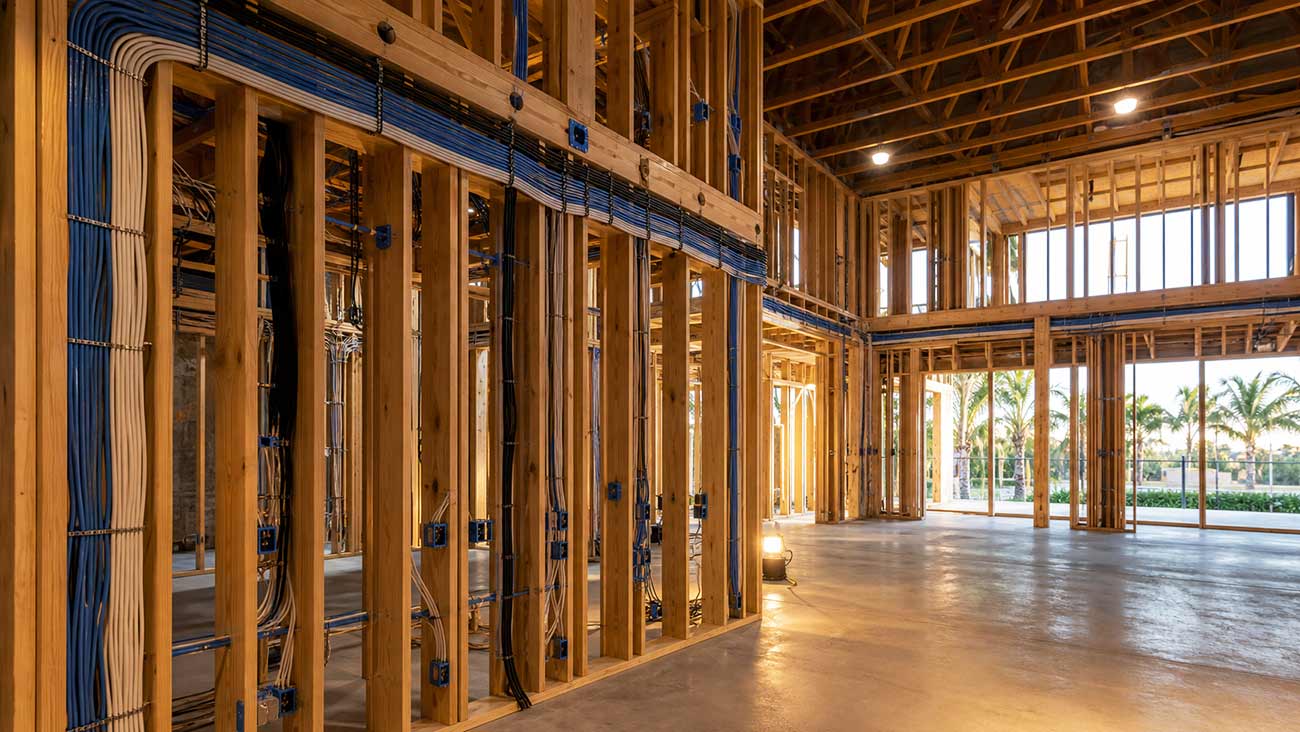
Build It Right the First Time: Smart Custom Home Builders Partner With a Low-Voltage Integrator Before Framing Starts
Your luxury clients in South and Central Florida are walking into showings with technology specifications. They have Pinterest boards of Crestron and Control4 interfaces. They are asking about Lutron Ketra lighting before the cabinets are selected. They are in love with Savant and Basalte touchpads and switches. They want hidden high-end speakers and flush-mounted TVs. In this market, the smart home is no longer a finish-phase conversation. It is a design-phase commitment, and the builders winning the best projects have a low-voltage partner locked in before the permit is pulled.
Definitive Electronics has worked alongside custom builders and general contractors across Palm Beach, Martin, Broward, Orange, and Miami-Dade counties since 1999. We operate as a dedicated technology trade partner, sequenced into your project timeline, coordinated with your subs, and accountable to your schedule, just as any professional trade is expected to be.
The Technology Infrastructure Behind the Smart Home
Low-voltage systems are a parallel trade scope that runs from pre-construction through commissioning. The full scope on a luxury residential build typically includes:
- Structured cabling: Cat6A Ethernet home runs, coaxial, and fiber backbone
- Home automation and control systems: Control4, Savant, Crestron, and Josh.ai
- Whole-home audio and distributed video: multi-zone speaker systems and video distribution
- Custom home theater and media rooms: acoustic pre-wire, projector drops, and equipment rack locations
- Lighting control: Lutron Ketra, Rania, and RadioRA processor and keypad locations
- Motorized shading and drapes: roller shade and drapery motor pre-wiring
- Security, access control, and surveillance: camera pre-wire, smart locks, and intercom rough-in
- Networking and structured Wi-Fi: wireless access point locations and network closet buildout
- Energy management: smart thermostat wiring, EV charging data prep, and battery storage integration
Getting all of this right is a function of early coordination. The further into the construction sequence these decisions get pushed, the more constrained and costly the solutions become.
RELATED: Orlando Smart Home Automation Starts Here ⇒
How We Fit Into Your Construction Schedule
Definitive Electronics works within the same phased structure you manage across every trade on the job.
Phase 1: Pre-Construction and Design Review
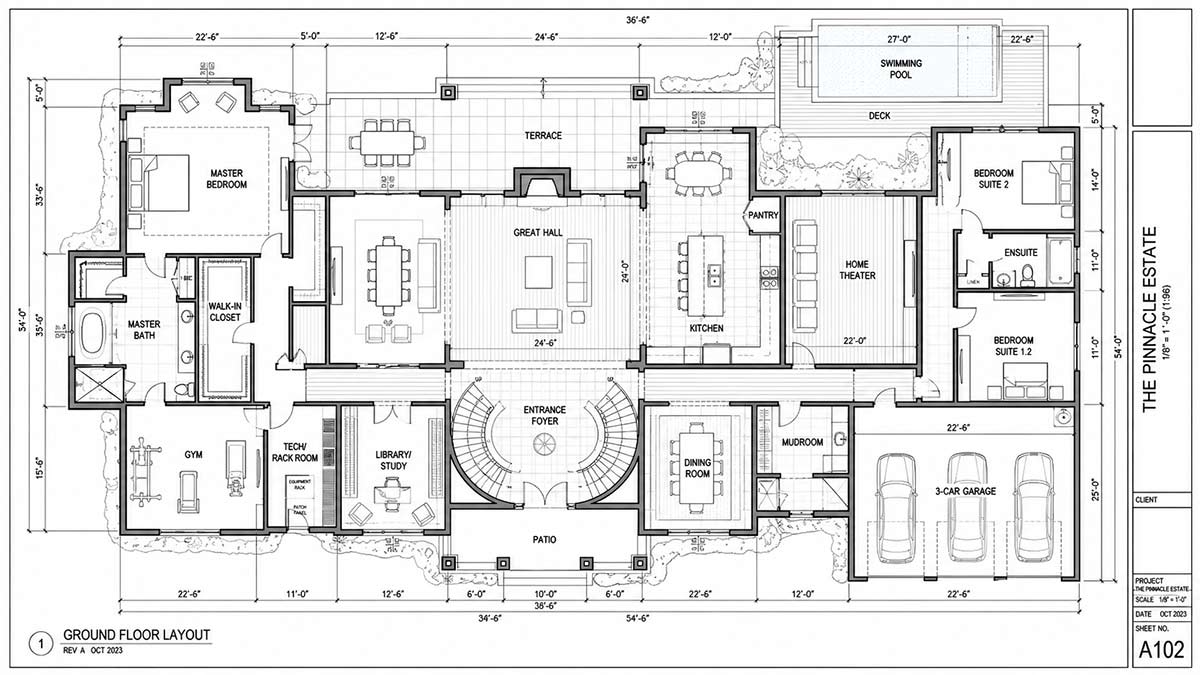
The highest-value conversation we can have is the one before plans are finalized. At the design review stage, we are examining floor and reflected ceiling plans to determine device locations, identifying the optimal positions for the structured media enclosure and network closet, and coordinating conduit pathways with the MEP drawings. We are also flagging any conflicts with HVAC chases, electrical panels, or plumbing runs before they become field problems. Any scope gaps or trade overlaps resolved at this phase stay off the change order log entirely.
Phase 2: Rough-In
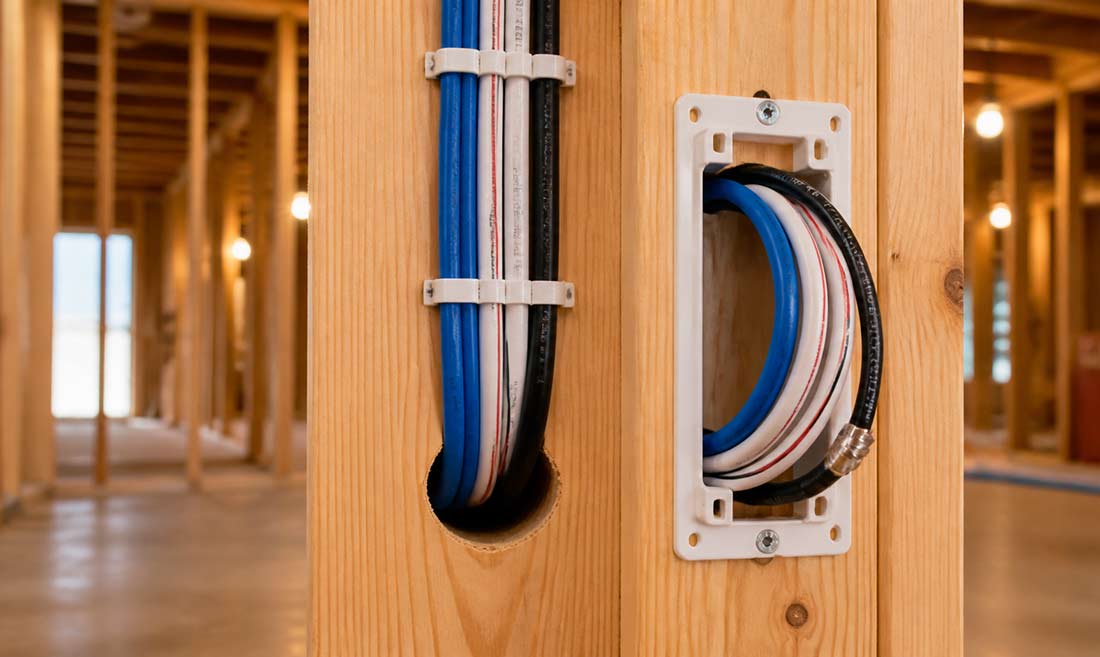
Our rough-in window opens after framing inspection and closes before insulation and drywall. During that window, we mount low-voltage brackets at every device location, drill and route all home-run cable to the structured media panel, install speaker back-boxes, and place conduit where future-proofing or code requirements call for it. Everything is labeled at both ends. For most luxury residential projects, that is a two- to five-day window, depending on the scope.
We coordinate directly with your electrical sub and HVAC contractor on plenum routing and vertical chases to prevent pathway conflicts in the ceiling. We show up on the schedule you provide, keep the work area clean, and document everything for your project records. In jurisdictions that require a low-voltage rough-in inspection, we have it covered and on file before walls close.
Phase 3: Trim-Out and Commissioning
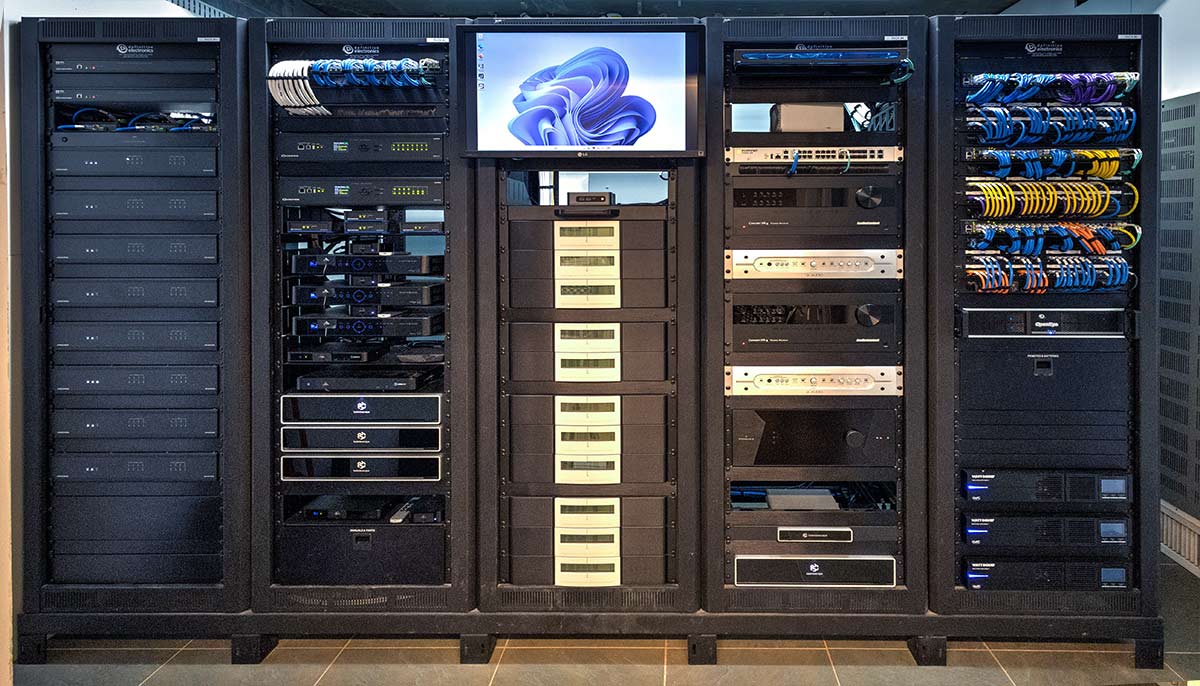
Once paint is done and finish trades are wrapping up, we return to terminate and certify all data drops, rack and stack the network closet, and mount and connect all camera and access-control hardware. We install all audio and video equipment, then commission and program every automation system. Every scene, schedule, and user interface is tested before your client’s walk-through. The home is technology-ready at closing, not a week after.
What We Bring to Your Project as a Trusted Trade Partner
We have seen the same pattern play out on projects where the technology contractor was not brought in early enough: problems that should have been resolved at design get resolved in the field, and the change order log reflects it. Our approach is built around eliminating that pattern from the start.
Before touching a tool on any project, we provide a written scope of work that defines every system, every cable run, every device location, and explicit trade exclusions. There is no ambiguity about where our scope ends and your electrical sub’s begins. We respond to RFIs, deliver as-built documentation, and keep your project manager informed throughout every phase. Lead times for premium automation equipment (Control4 processors, Lutron systems, and custom rack components) are managed at the design phase, so trim-out is never waiting on back-ordered gear.
Have a project currently in framing?
If walls are still open, we can get your rough-in on the schedule.
👉 Request a VIP Builder Consultation
What the Luxury Market Expects in 2026
Southeast Florida and Orlando home buyers at the top of the market are not treating smart home technology as an upgrade tier. They are treating it as a baseline expectation. Properties with integrated smart home systems are commanding resale premiums of up to 5% over comparable non-integrated homes. Luxury developments from Orlando to Miami are actively marketing AI-ready wiring infrastructure, tunable circadian lighting, and whole-home automation as defining features of the build.

The systems your buyers expect to find commissioned and working at closing include:
- Unified automation platform (Control4, Savant, or Crestron): one interface for lighting, shading, climate, audio/video, and security
- Circadian and tunable lighting (Lutron Ketra): wellness-driven illumination that adjusts throughout the day
- Motorized shades and drapes: particularly important for waterfront properties, managing solar heat gain in Florida
- Whole-home audio: distributed multi-zone music throughout indoor and outdoor living spaces
- Custom home theaters: private cinema rooms with full acoustic and AV pre-wire
- Biometric access control: smart locks, facial recognition entry, and multi-point security
- PoE surveillance cameras: Power-over-Ethernet cameras fully integrated with the automation platform
- Robust whole-home Wi-Fi: access point locations designed for seamless coverage from the framing stage
- Outdoor entertainment infrastructure: covered lanai audio, weatherproof displays, and pool and spa automation
Builders across Florida are also pre-wiring for solar integration and battery storage as energy resilience becomes a standard specification in coastal markets.
New Construction and Renovation: We Do Both
A significant portion of the luxury residential market in South and Central Florida involves renovation, additions, and whole-floor remodels rather than new construction. The opportunity for technology integration is just as real; the constraint is the same: open walls. When a renovation project opens walls, that is the window for low-voltage infrastructure work.
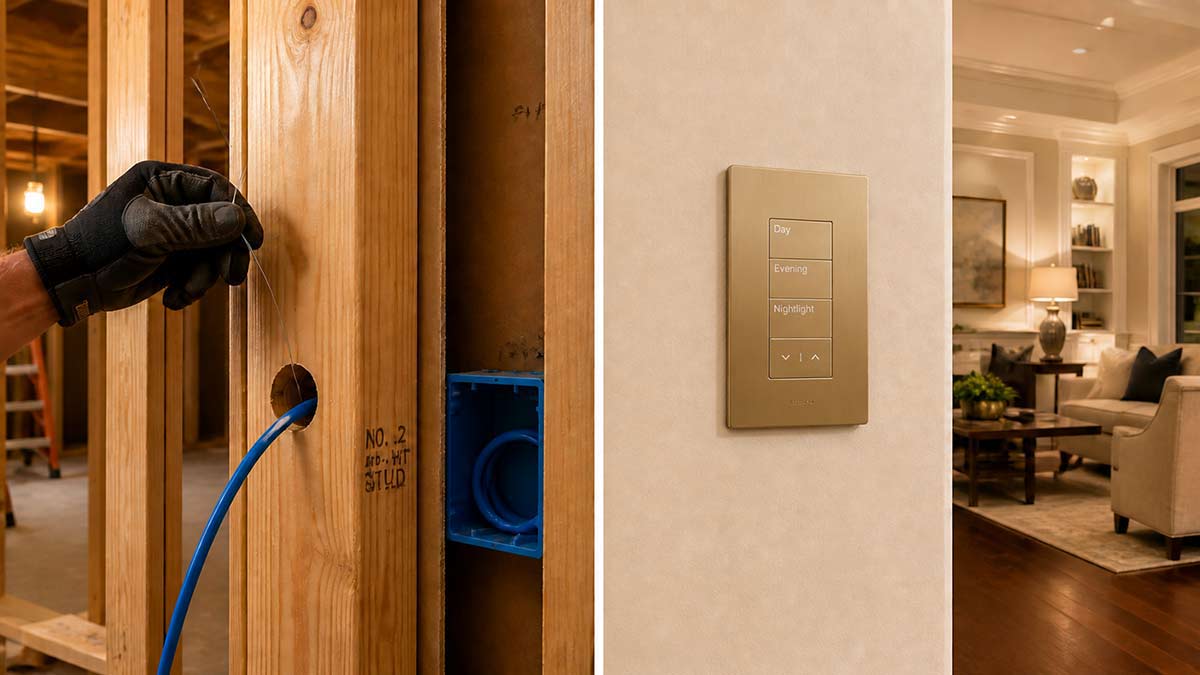
In existing homes, we fish cables through wall cavities, ceiling spaces, and attic runs. The approach is more precise than new construction, but the result is the same: a clean, documented, labeled system that integrates seamlessly with the rest of the home’s finishes. We coordinate directly with your project manager and active subs to complete our scope while access is available, without creating additional disruption to completed areas.
Remodel or renovation currently in progress?
👉 Talk to Our Builder Team
Why Builders Make Definitive Electronics Their Preferred Technology Partner
Custom builders and general contractors who bring Definitive Electronics onto their projects are adding a dedicated technology trade partner to their permanent build team. The practical value shows up at every stage of the project.
Your reputation is built on what your clients experience from day one. A smart home that functions exactly as designed at move-in reflects on the build. A technology system that needs weeks of callbacks after closing also reflects on the build. We hold ourselves to the same standard you hold every trade on your job to: show up on schedule, deliver clean, documented work, and leave the project better than you found it.
Early engagement also directly reduces change order exposure. Scope gaps and trade conflicts resolved at design review cost nothing. The same issues found in the field become line items on a change order.
Definitive Electronics holds HTA (Home Technology Association) Estate-Level certification and is a Crestron, Control4, Lutron, and Savant Certified Integration Partner. We have been part of the Southeast Florida luxury residential construction community since 1999.
Schedule a Builder Consultation
Whether you are in design, in framing, or mid-renovation, we will meet you where the project is. Definitive Electronics offers complimentary pre-construction consultations for custom builders and general contractors. We will review your architectural plans, identify the technology scope your clients expect, and deliver a written proposal that aligns with your construction timeline.
Let’s Talk Before Framing Starts. Contact Definitive Electronics today!
Serving custom builders and GCs throughout Palm Beach, Martin, Broward, Miami-Dade, Orange, and across Central and South Florida.
FAQs: Choosing the Right Custom Integration Partner for Your Build
What certifications should a residential technology integrator hold?
Certifications are the fastest way to separate professional firms from unqualified ones. The two credentials that matter most in luxury residential integration are HTA (Home Technology Association) certification and CEDIA membership with individually certified technicians. HTA Estate-Level is the highest residential credentialing tier in the industry and requires demonstrated expertise across a defined set of systems and project complexity. Beyond industry credentials, ask whether the firm holds current manufacturer certifications for the specific platforms they are specifying on your project: a Control4 Certified Dealer, a Lutron Preferred Partner, and a Crestron Authorized Dealer carry different levels of manufacturer-backed accountability, training, and warranty support than a dealer who simply purchases equipment through distribution. Ask to see the credentials, not just the claims.
What is the difference between a commodity low-voltage wiring contractor and a full-service integration firm?
A commodity low-voltage contractor will typically pull the wire that is shown on the plan, terminate jacks, and hang devices. Their role often stops at “what and where” the prints call for. A full-service custom integrator like Definitive Electronics handles the entire technology package: system design and engineering, low-voltage rough-in and conduit placement, device installation, rack build, programming and commissioning, and ongoing service and support. This matters on a luxury build because the client experience comes from the combination of infrastructure, equipment selection, and the way the system is programmed to fit the way the family actually lives, not just from having cable in the walls. When you evaluate firms, ask whether they both self-perform the low-voltage wiring and have dedicated designers and programmers on staff, or whether they outsource those pieces to others.
How do we verify an integrator’s quality of work before committing to a project?
Ask for a portfolio of completed projects with photos and, where possible, client walk-throughs. Serious firms maintain documentation of their installations and can show you finished equipment rooms, labeled cable runs, and commissioned systems. Ask specifically to see their structured media enclosure and rack work: the quality of a firm’s rack builds and cable management is a direct indicator of their overall workmanship standards throughout the project. Also, ask how they handle as-built documentation, cable test certification results, and their closeout package at project completion. Firms that cannot produce detailed as-built drawings and certified cable test results at closeout create ongoing service problems for the homeowner and your trade record.
Who actually does the work on the job site, and will the same crew be there throughout?
This question reveals more about a firm than almost any other. Ask directly whether all field technicians are employees of the company or whether the firm subcontracts installation to outside labor. Companies that use in-house, trained, background-checked technicians deliver more consistent workmanship and are more accountable to project timelines and quality standards than firms that staff up with temporary or subcontracted labor for each job. Also, ask whether a dedicated project manager or lead technician will be assigned to your project from rough-in through commissioning, or whether different personnel rotate through. Continuity on the job site directly affects coordination quality with your other trades.
How should payment milestones be structured for a low-voltage integration contract?
Payment milestones should be tied to verified project deliverables, not calendar dates. A well-structured contract typically phases payments at: design completion and equipment order, rough-in completion, trim-out completion, and final commissioning sign-off. Be cautious of contracts that require large upfront payments before equipment is ordered or that front-load payments before deliverables are confirmed. Equally important is understanding what the change order process looks like: ask for written documentation of how scope changes are identified, priced, and approved before work proceeds. A firm with a clear, documented change order process is unlikely to generate surprise invoices at project closeout.
What warranty and post-installation support does the integrator provide?
Warranty coverage in residential integration has two distinct components: the manufacturer’s product warranty (covering hardware defects) and the integrator’s labor and programming warranty (covering installation quality and system performance). Ask explicitly what the labor warranty covers, how long it runs, and what happens when a manufacturer discontinues support for a platform. Beyond warranty, ask what the firm’s ongoing service model looks like: do they offer remote monitoring and diagnostics, remote programming updates, and a defined response time for service calls? For a high-net-worth client in a luxury home, system downtime is not a minor inconvenience. An integrator without a structured service program cannot be a long-term partner for your clients.
What should be included in the integrator’s scope of work document before we sign?
A professional integrator should provide a written scope of work that includes a full equipment list with model numbers, a room-by-room device-location schedule, explicit trade exclusions that define what their scope does not cover, a construction-phase schedule tied to your project timeline, and a commissioning and testing protocol. Vague scopes of work are the primary source of change orders and disputes on technology projects. If a firm cannot produce a detailed written scope before contract execution, that is a significant red flag. The scope document should be specific enough that any qualified integrator could read it and understand exactly what is being installed, where, and how.
Can the same integrator handle both new construction and renovation projects?
Not all integration firms are equally capable across both project types. New construction, pre-wire, and renovation retrofit require different skill sets, different tooling, and different problem-solving approaches. In new construction, the work primarily involves precision routing, proper conduit placement, and coordination with other trades during the rough-in window. In renovation work, the premium is on minimizing drywall disruption, identifying existing pathways, and working within the constraints of a finished or partially finished home without creating additional damage. Ask any firm you are considering to walk you through their specific process for renovation projects, and ask for examples of retrofit work in existing homes of similar complexity to your project.
What does “future-proofing” actually mean, and how do we evaluate those claims?
Meaningful future-proofing in a luxury residential installation means: Cat6A cabling (not Cat5e or Cat6) pulled to every device location and above ceilings for future access point placement, conduit installed in walls where technology is likely to evolve, an equipment room sized generously enough to accommodate additional rack space, and an open-platform or IP-based control system that can integrate with new devices and protocols as they emerge. Ask specifically what cable category is being specified and why, whether conduit is included in the scope, and what the upgrade path looks like for the control platform being specified. A firm that cannot answer those questions concretely is using “future-proof” as a marketing phrase rather than a design commitment.
How do we evaluate a firm’s ability to coordinate with our other trade partners?
Ask the integrator how they communicate with your project manager and other subs, whether they use project management tools that integrate with platforms like Procore or Buildertrend, and how they handle RFI responses and submittals. Ask for a sample of their rough-in coordination drawing and a sample of their closeout documentation package. A firm that can show you those materials before the project starts has built a repeatable, professional process. A firm that cannot show you those materials is a firm that is figuring it out as they go, and your project timeline will reflect that.
Our Growing Florida Service Areas
Definitive Electronics serves homeowners, builders, designers, and architects across many of Florida’s most distinguished communities, from South Florida’s coastline to Central Florida and the Gulf Coast, including:
Palm Beach County
Palm Beach, Boca Raton, Delray Beach, Jupiter, Jupiter Island, Manalapan, Boynton Beach, Wellington, Highland Beach, Palm Beach Gardens, West Palm Beach, and surrounding communities
Martin County
Stuart, Hobe Sound, Palm City, Sewall’s Point, Hutchinson Island, and nearby waterfront and golf communities
Broward County
Fort Lauderdale, Lighthouse Point, Weston, Coral Springs, Parkland, and coastal and nearby neighborhoods
Miami-Dade County
Miami, Miami Beach, Coral Gables, Key Biscayne, Bal Harbour, Aventura, Coconut Grove, and surrounding communities
Indian River County
Indian River Shores, Orchid, Sebastian, Vero Beach, Wabasso, Windsor
Orange County
Orlando, Windermere, Lake Nona, Winter Park, Isleworth, Keene’s Pointe, Golden Oak, and other Central Florida communities
Tampa Bay Area (Hillsborough and Pinellas Counties)
Tampa, St. Petersburg, Clearwater, Belleair, Palm Harbor, Tierra Verde, and surrounding residential areas
Oceanfront estates, canal properties, private golf communities, luxury condominiums, and new construction projects all benefit from integrated home technology solutions.
Wherever you are within our Florida Service Areas, Definitive Electronics is ready to bring thoughtful design, seamless control, and reliable performance into your space.
Like what you see? Share this post.
Table of Contents
Categories
Build It Right the First Time: Smart Custom Home Builders Partner With a Low-Voltage Integrator Before Framing Starts
Your luxury clients in South and Central Florida are walking into showings with technology specifications. They have Pinterest boards of Crestron and Control4 interfaces. They are asking about Lutron Ketra lighting before the cabinets are selected. They are in love with Savant and Basalte touchpads and switches. They want hidden high-end speakers and flush-mounted TVs. In this market, the smart home is no longer a finish-phase conversation. It is a design-phase commitment, and the builders winning the best projects have a low-voltage partner locked in before the permit is pulled.
Definitive Electronics has worked alongside custom builders and general contractors across Palm Beach, Martin, Broward, Orange, and Miami-Dade counties since 1999. We operate as a dedicated technology trade partner, sequenced into your project timeline, coordinated with your subs, and accountable to your schedule, just as any professional trade is expected to be.
The Technology Infrastructure Behind the Smart Home
Low-voltage systems are a parallel trade scope that runs from pre-construction through commissioning. The full scope on a luxury residential build typically includes:
- Structured cabling: Cat6A Ethernet home runs, coaxial, and fiber backbone
- Home automation and control systems: Control4, Savant, Crestron, and Josh.ai
- Whole-home audio and distributed video: multi-zone speaker systems and video distribution
- Custom home theater and media rooms: acoustic pre-wire, projector drops, and equipment rack locations
- Lighting control: Lutron Ketra, Rania, and RadioRA processor and keypad locations
- Motorized shading and drapes: roller shade and drapery motor pre-wiring
- Security, access control, and surveillance: camera pre-wire, smart locks, and intercom rough-in
- Networking and structured Wi-Fi: wireless access point locations and network closet buildout
- Energy management: smart thermostat wiring, EV charging data prep, and battery storage integration
Getting all of this right is a function of early coordination. The further into the construction sequence these decisions get pushed, the more constrained and costly the solutions become.
RELATED: Orlando Smart Home Automation Starts Here ⇒
How We Fit Into Your Construction Schedule
Definitive Electronics works within the same phased structure you manage across every trade on the job.
Phase 1: Pre-Construction and Design Review
The highest-value conversation we can have is the one before plans are finalized. At the design review stage, we are examining floor and reflected ceiling plans to determine device locations, identifying the optimal positions for the structured media enclosure and network closet, and coordinating conduit pathways with the MEP drawings. We are also flagging any conflicts with HVAC chases, electrical panels, or plumbing runs before they become field problems. Any scope gaps or trade overlaps resolved at this phase stay off the change order log entirely.
Phase 2: Rough-In
Our rough-in window opens after framing inspection and closes before insulation and drywall. During that window, we mount low-voltage brackets at every device location, drill and route all home-run cable to the structured media panel, install speaker back-boxes, and place conduit where future-proofing or code requirements call for it. Everything is labeled at both ends. For most luxury residential projects, that is a two- to five-day window, depending on the scope.
We coordinate directly with your electrical sub and HVAC contractor on plenum routing and vertical chases to prevent pathway conflicts in the ceiling. We show up on the schedule you provide, keep the work area clean, and document everything for your project records. In jurisdictions that require a low-voltage rough-in inspection, we have it covered and on file before walls close.
Phase 3: Trim-Out and Commissioning
Once paint is done and finish trades are wrapping up, we return to terminate and certify all data drops, rack and stack the network closet, and mount and connect all camera and access-control hardware. We install all audio and video equipment, then commission and program every automation system. Every scene, schedule, and user interface is tested before your client’s walk-through. The home is technology-ready at closing, not a week after.
What We Bring to Your Project as a Trusted Trade Partner
We have seen the same pattern play out on projects where the technology contractor was not brought in early enough: problems that should have been resolved at design get resolved in the field, and the change order log reflects it. Our approach is built around eliminating that pattern from the start.
Before touching a tool on any project, we provide a written scope of work that defines every system, every cable run, every device location, and explicit trade exclusions. There is no ambiguity about where our scope ends and your electrical sub’s begins. We respond to RFIs, deliver as-built documentation, and keep your project manager informed throughout every phase. Lead times for premium automation equipment (Control4 processors, Lutron systems, and custom rack components) are managed at the design phase, so trim-out is never waiting on back-ordered gear.
Have a project currently in framing?
If walls are still open, we can get your rough-in on the schedule.
👉 Request a VIP Builder Consultation
What the Luxury Market Expects in 2026
Southeast Florida and Orlando home buyers at the top of the market are not treating smart home technology as an upgrade tier. They are treating it as a baseline expectation. Properties with integrated smart home systems are commanding resale premiums of up to 5% over comparable non-integrated homes. Luxury developments from Orlando to Miami are actively marketing AI-ready wiring infrastructure, tunable circadian lighting, and whole-home automation as defining features of the build.
The systems your buyers expect to find commissioned and working at closing include:
- Unified automation platform (Control4, Savant, or Crestron): one interface for lighting, shading, climate, audio/video, and security
- Circadian and tunable lighting (Lutron Ketra): wellness-driven illumination that adjusts throughout the day
- Motorized shades and drapes: particularly important for waterfront properties, managing solar heat gain in Florida
- Whole-home audio: distributed multi-zone music throughout indoor and outdoor living spaces
- Custom home theaters: private cinema rooms with full acoustic and AV pre-wire
- Biometric access control: smart locks, facial recognition entry, and multi-point security
- PoE surveillance cameras: Power-over-Ethernet cameras fully integrated with the automation platform
- Robust whole-home Wi-Fi: access point locations designed for seamless coverage from the framing stage
- Outdoor entertainment infrastructure: covered lanai audio, weatherproof displays, and pool and spa automation
Builders across Florida are also pre-wiring for solar integration and battery storage as energy resilience becomes a standard specification in coastal markets.
New Construction and Renovation: We Do Both
A significant portion of the luxury residential market in South and Central Florida involves renovation, additions, and whole-floor remodels rather than new construction. The opportunity for technology integration is just as real; the constraint is the same: open walls. When a renovation project opens walls, that is the window for low-voltage infrastructure work.
In existing homes, we fish cables through wall cavities, ceiling spaces, and attic runs. The approach is more precise than new construction, but the result is the same: a clean, documented, labeled system that integrates seamlessly with the rest of the home’s finishes. We coordinate directly with your project manager and active subs to complete our scope while access is available, without creating additional disruption to completed areas.
Remodel or renovation currently in progress?
👉 Talk to Our Builder Team
Why Builders Make Definitive Electronics Their Preferred Technology Partner
Custom builders and general contractors who bring Definitive Electronics onto their projects are adding a dedicated technology trade partner to their permanent build team. The practical value shows up at every stage of the project.
Your reputation is built on what your clients experience from day one. A smart home that functions exactly as designed at move-in reflects on the build. A technology system that needs weeks of callbacks after closing also reflects on the build. We hold ourselves to the same standard you hold every trade on your job to: show up on schedule, deliver clean, documented work, and leave the project better than you found it.
Early engagement also directly reduces change order exposure. Scope gaps and trade conflicts resolved at design review cost nothing. The same issues found in the field become line items on a change order.
Definitive Electronics holds HTA (Home Technology Association) Estate-Level certification and is a Crestron, Control4, Lutron, and Savant Certified Integration Partner. We have been part of the Southeast Florida luxury residential construction community since 1999.
Schedule a Builder Consultation
Whether you are in design, in framing, or mid-renovation, we will meet you where the project is. Definitive Electronics offers complimentary pre-construction consultations for custom builders and general contractors. We will review your architectural plans, identify the technology scope your clients expect, and deliver a written proposal that aligns with your construction timeline.
Let’s Talk Before Framing Starts. Contact Definitive Electronics today!
Serving custom builders and GCs throughout Palm Beach, Martin, Broward, Miami-Dade, Orange, and across Central and South Florida.
FAQs: Choosing the Right Custom Integration Partner for Your Build
What certifications should a residential technology integrator hold?
Certifications are the fastest way to separate professional firms from unqualified ones. The two credentials that matter most in luxury residential integration are HTA (Home Technology Association) certification and CEDIA membership with individually certified technicians. HTA Estate-Level is the highest residential credentialing tier in the industry and requires demonstrated expertise across a defined set of systems and project complexity. Beyond industry credentials, ask whether the firm holds current manufacturer certifications for the specific platforms they are specifying on your project: a Control4 Certified Dealer, a Lutron Preferred Partner, and a Crestron Authorized Dealer carry different levels of manufacturer-backed accountability, training, and warranty support than a dealer who simply purchases equipment through distribution. Ask to see the credentials, not just the claims.
What is the difference between a commodity low-voltage wiring contractor and a full-service integration firm?
A commodity low-voltage contractor will typically pull the wire that is shown on the plan, terminate jacks, and hang devices. Their role often stops at “what and where” the prints call for. A full-service custom integrator like Definitive Electronics handles the entire technology package: system design and engineering, low-voltage rough-in and conduit placement, device installation, rack build, programming and commissioning, and ongoing service and support. This matters on a luxury build because the client experience comes from the combination of infrastructure, equipment selection, and the way the system is programmed to fit the way the family actually lives, not just from having cable in the walls. When you evaluate firms, ask whether they both self-perform the low-voltage wiring and have dedicated designers and programmers on staff, or whether they outsource those pieces to others.
How do we verify an integrator’s quality of work before committing to a project?
Ask for a portfolio of completed projects with photos and, where possible, client walk-throughs. Serious firms maintain documentation of their installations and can show you finished equipment rooms, labeled cable runs, and commissioned systems. Ask specifically to see their structured media enclosure and rack work: the quality of a firm’s rack builds and cable management is a direct indicator of their overall workmanship standards throughout the project. Also, ask how they handle as-built documentation, cable test certification results, and their closeout package at project completion. Firms that cannot produce detailed as-built drawings and certified cable test results at closeout create ongoing service problems for the homeowner and your trade record.
Who actually does the work on the job site, and will the same crew be there throughout?
This question reveals more about a firm than almost any other. Ask directly whether all field technicians are employees of the company or whether the firm subcontracts installation to outside labor. Companies that use in-house, trained, background-checked technicians deliver more consistent workmanship and are more accountable to project timelines and quality standards than firms that staff up with temporary or subcontracted labor for each job. Also, ask whether a dedicated project manager or lead technician will be assigned to your project from rough-in through commissioning, or whether different personnel rotate through. Continuity on the job site directly affects coordination quality with your other trades.
How should payment milestones be structured for a low-voltage integration contract?
Payment milestones should be tied to verified project deliverables, not calendar dates. A well-structured contract typically phases payments at: design completion and equipment order, rough-in completion, trim-out completion, and final commissioning sign-off. Be cautious of contracts that require large upfront payments before equipment is ordered or that front-load payments before deliverables are confirmed. Equally important is understanding what the change order process looks like: ask for written documentation of how scope changes are identified, priced, and approved before work proceeds. A firm with a clear, documented change order process is unlikely to generate surprise invoices at project closeout.
What warranty and post-installation support does the integrator provide?
Warranty coverage in residential integration has two distinct components: the manufacturer’s product warranty (covering hardware defects) and the integrator’s labor and programming warranty (covering installation quality and system performance). Ask explicitly what the labor warranty covers, how long it runs, and what happens when a manufacturer discontinues support for a platform. Beyond warranty, ask what the firm’s ongoing service model looks like: do they offer remote monitoring and diagnostics, remote programming updates, and a defined response time for service calls? For a high-net-worth client in a luxury home, system downtime is not a minor inconvenience. An integrator without a structured service program cannot be a long-term partner for your clients.
What should be included in the integrator’s scope of work document before we sign?
A professional integrator should provide a written scope of work that includes a full equipment list with model numbers, a room-by-room device-location schedule, explicit trade exclusions that define what their scope does not cover, a construction-phase schedule tied to your project timeline, and a commissioning and testing protocol. Vague scopes of work are the primary source of change orders and disputes on technology projects. If a firm cannot produce a detailed written scope before contract execution, that is a significant red flag. The scope document should be specific enough that any qualified integrator could read it and understand exactly what is being installed, where, and how.
Can the same integrator handle both new construction and renovation projects?
Not all integration firms are equally capable across both project types. New construction, pre-wire, and renovation retrofit require different skill sets, different tooling, and different problem-solving approaches. In new construction, the work primarily involves precision routing, proper conduit placement, and coordination with other trades during the rough-in window. In renovation work, the premium is on minimizing drywall disruption, identifying existing pathways, and working within the constraints of a finished or partially finished home without creating additional damage. Ask any firm you are considering to walk you through their specific process for renovation projects, and ask for examples of retrofit work in existing homes of similar complexity to your project.
What does “future-proofing” actually mean, and how do we evaluate those claims?
Meaningful future-proofing in a luxury residential installation means: Cat6A cabling (not Cat5e or Cat6) pulled to every device location and above ceilings for future access point placement, conduit installed in walls where technology is likely to evolve, an equipment room sized generously enough to accommodate additional rack space, and an open-platform or IP-based control system that can integrate with new devices and protocols as they emerge. Ask specifically what cable category is being specified and why, whether conduit is included in the scope, and what the upgrade path looks like for the control platform being specified. A firm that cannot answer those questions concretely is using “future-proof” as a marketing phrase rather than a design commitment.
How do we evaluate a firm’s ability to coordinate with our other trade partners?
Ask the integrator how they communicate with your project manager and other subs, whether they use project management tools that integrate with platforms like Procore or Buildertrend, and how they handle RFI responses and submittals. Ask for a sample of their rough-in coordination drawing and a sample of their closeout documentation package. A firm that can show you those materials before the project starts has built a repeatable, professional process. A firm that cannot show you those materials is a firm that is figuring it out as they go, and your project timeline will reflect that.
Our Growing Florida Service Areas
Definitive Electronics serves homeowners, builders, designers, and architects across many of Florida’s most distinguished communities, from South Florida’s coastline to Central Florida and the Gulf Coast, including:
Palm Beach County
Palm Beach, Boca Raton, Delray Beach, Jupiter, Jupiter Island, Manalapan, Boynton Beach, Wellington, Highland Beach, Palm Beach Gardens, West Palm Beach, and surrounding communities
Martin County
Stuart, Hobe Sound, Palm City, Sewall’s Point, Hutchinson Island, and nearby waterfront and golf communities
Broward County
Fort Lauderdale, Lighthouse Point, Weston, Coral Springs, Parkland, and coastal and nearby neighborhoods
Miami-Dade County
Miami, Miami Beach, Coral Gables, Key Biscayne, Bal Harbour, Aventura, Coconut Grove, and surrounding communities
Indian River County
Indian River Shores, Orchid, Sebastian, Vero Beach, Wabasso, Windsor
Orange County
Orlando, Windermere, Lake Nona, Winter Park, Isleworth, Keene’s Pointe, Golden Oak, and other Central Florida communities
Tampa Bay Area (Hillsborough and Pinellas Counties)
Tampa, St. Petersburg, Clearwater, Belleair, Palm Harbor, Tierra Verde, and surrounding residential areas
Oceanfront estates, canal properties, private golf communities, luxury condominiums, and new construction projects all benefit from integrated home technology solutions.
Wherever you are within our Florida Service Areas, Definitive Electronics is ready to bring thoughtful design, seamless control, and reliable performance into your space.