


Home Theater or Media Room: Which Is Right for Your Orlando Home?
You already have the house. Now you have a room that could be doing so much more.
Perhaps it’s an unused bonus room, den, game room, secondary living area, or formal space your family rarely uses. Or maybe your great room is where everyone gathers, but the existing television and audio system are just no longer good enough.
The question becomes: Should you turn the space into a dedicated home theater or create a high-performance media room?
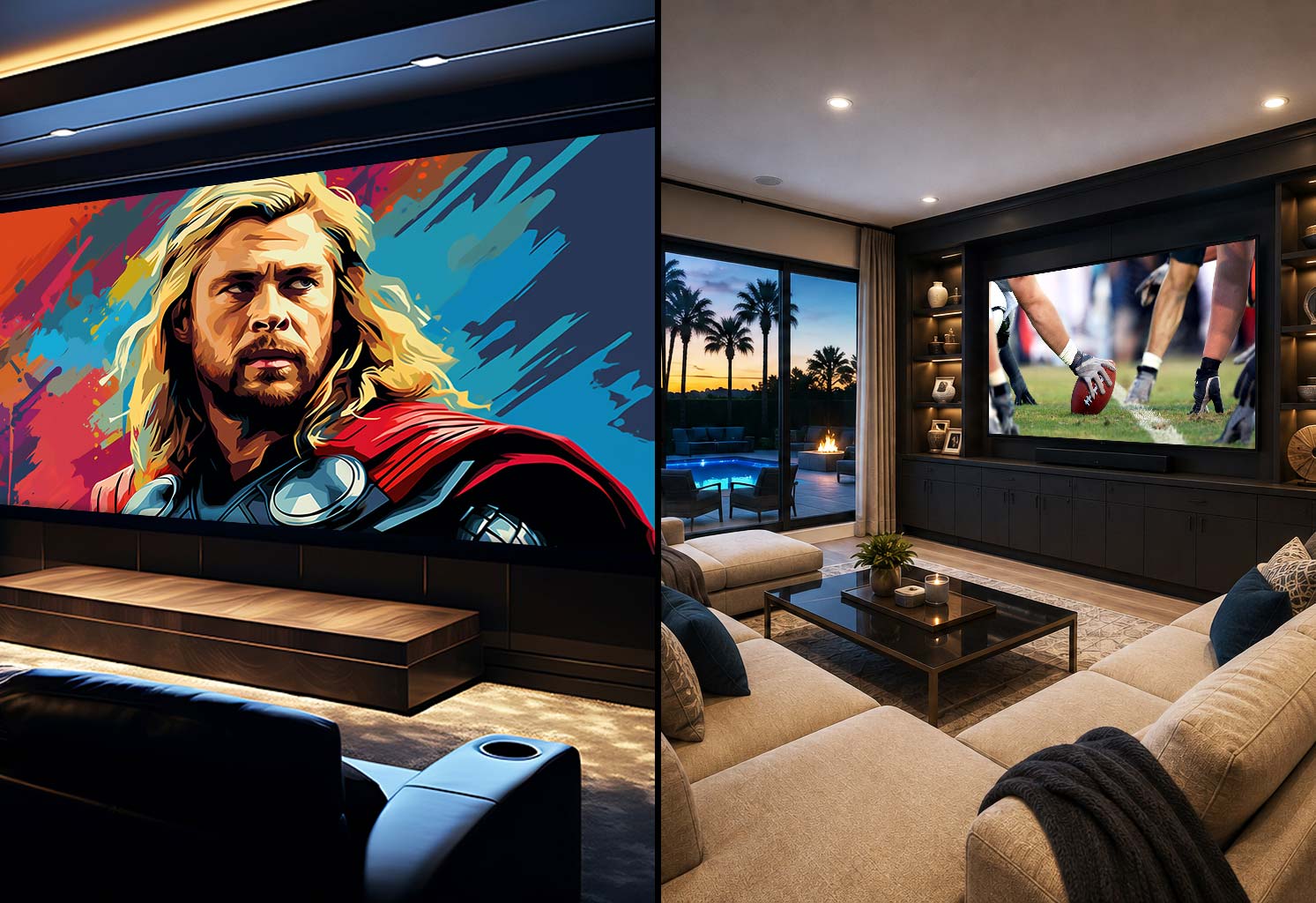
The distinction matters. A home theater and a media room are not simply two versions of the same entertainment space at different price points. They serve different purposes and place different demands on the room.
This guide focuses primarily on existing Orlando homes and retrofit projects. Unlike designing a home theater for a new construction project, a retrofit begins with the architecture already in place. Room dimensions, windows, ceiling height, HVAC, wiring access, adjacent spaces, and the amount of renovation you are comfortable undertaking all help determine what makes sense for your entertainment goals.
The goal is not to force an existing room into a preconceived design. It’s about understanding what the space can support and creating the best entertainment experience for the way you and your family live.
Key Takeaways
- A dedicated home theater prioritizes cinematic immersion. Light control, immersive audio, acoustics, seating, and the display are designed around serious movie and entertainment viewing.
- A media room is designed for multiple uses. It may combine movies, sports, gaming, music, entertaining, and everyday family life in one comfortable space.
- Your existing room matters. Windows, dimensions, ceiling height, HVAC, adjacent rooms, and wiring access can influence which approach makes the most sense.
- A theater does not have to mean a projector. Projection remains an excellent choice, but premium direct-view displays and MicroLED can also be used in dedicated entertainment spaces.
- Retrofitting does not necessarily mean major construction. Some rooms can be transformed with relatively targeted improvements, while others justify a more extensive renovation.
- Start with the room, not the equipment. Display size, speakers, seating, lighting, shades, and control should be selected after the space and your goals have been evaluated.
Considering an entertainment upgrade in your Orlando home?
Definitive Electronics can evaluate your existing space and help determine whether a dedicated theater, media room, or another approach will deliver the experience you want.
👉 Schedule a private consultation.
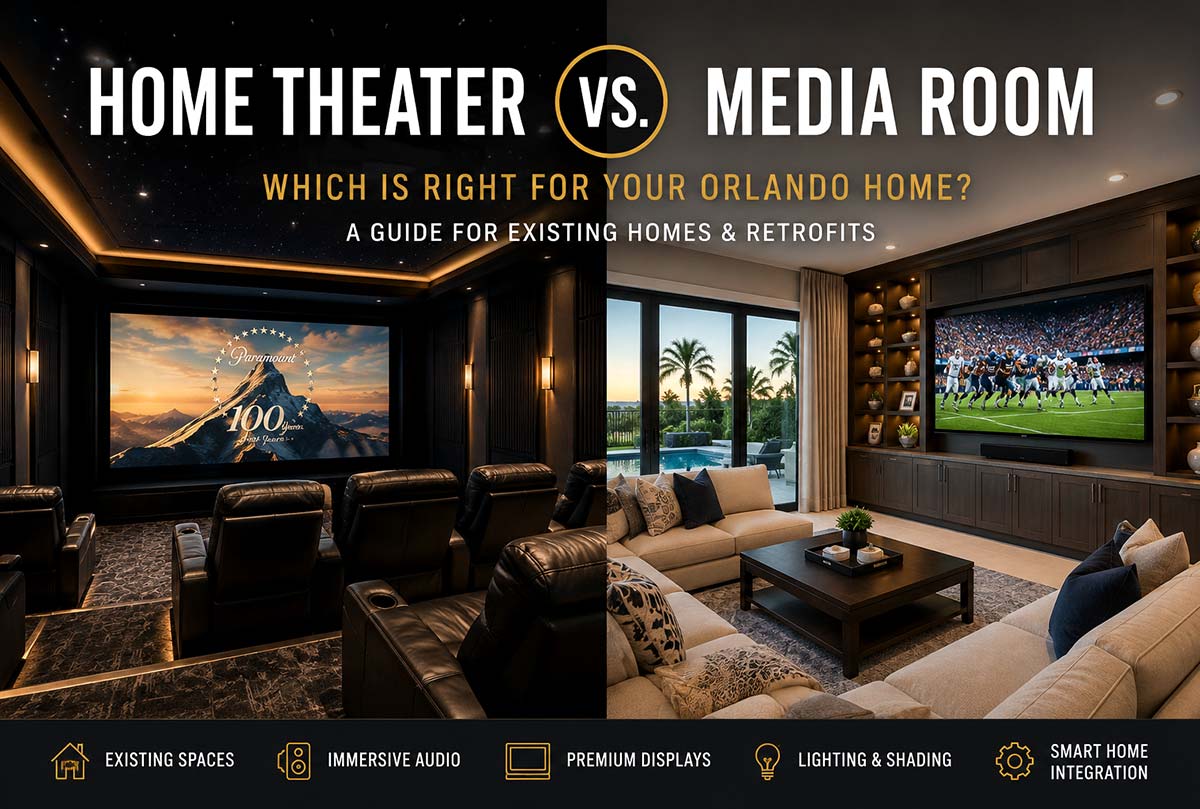
Home Theater vs. Media Room: The Core Difference
A dedicated home theater is built primarily around the viewing experience.
The room is typically enclosed, with controlled lighting, carefully planned seating, immersive surround sound, and acoustics designed to support high-performance audio. Technology and architecture work together to create an environment where movies, concerts, sports, and other content take center stage.
A media room operates differently.
It is part entertainment space and part living space. You might watch a movie on Friday night, host friends for football on Sunday, play games with the family, stream a concert, or simply have music playing while everyone talks.
The technology can still be exceptional. It simply shares the room with other priorities.
| Feature | Dedicated Home Theater | Media Room |
|---|---|---|
| Primary purpose | Immersive viewing | Multipurpose entertainment |
| Room configuration | Usually enclosed | Enclosed, open, or semi-open |
| Light control | High level of control preferred | Ambient light can be managed |
| Display | Projection, large-format display, or direct-view LED | Large-format TV, video wall, or other direct-view display |
| Audio | Immersive surround with acoustic consideration | Architectural surround or immersive audio |
| Seating | Viewing-oriented, sometimes tiered | Sectionals, lounge seating, flexible arrangements |
| Acoustics | Often a major design priority | Integrated according to room and performance goals |
| Renovation | Can be more extensive | Often adaptable to existing architecture |
Neither approach is inherently better.
Ask yourself: Which experience makes the most sense for the room you already have?
Can Your Existing Room Become a Home Theater?
There’s no universal minimum room size that determines whether a space can become a home theater.
An unused bonus room, game room, den, bedroom, loft, or other enclosed space may be a candidate. What matters is how its dimensions and existing architecture affect the experience you want to create.
A professional evaluation should consider:
- Room width, length, and ceiling height
- Number of desired seats
- Viewing distance
- Screen size and location
- Speaker placement
- Windows and doors
- HVAC supply and return locations
- Noise from adjacent rooms
- Wiring access
- Equipment location
- Lighting
- Potential acoustic improvements
A larger room provides more flexibility for multiple seating rows, larger displays, speaker placement, circulation, and acoustic treatment. Smaller spaces can still produce impressive results when the system is designed around the room rather than forcing equipment into an unsuitable layout.
What About an Open Room?
An open great room or living area can deliver an extraordinary entertainment experience, but it’s generally better suited to a media room than to a traditional dedicated theater.
That doesn’t mean settling for a standard television and soundbar.
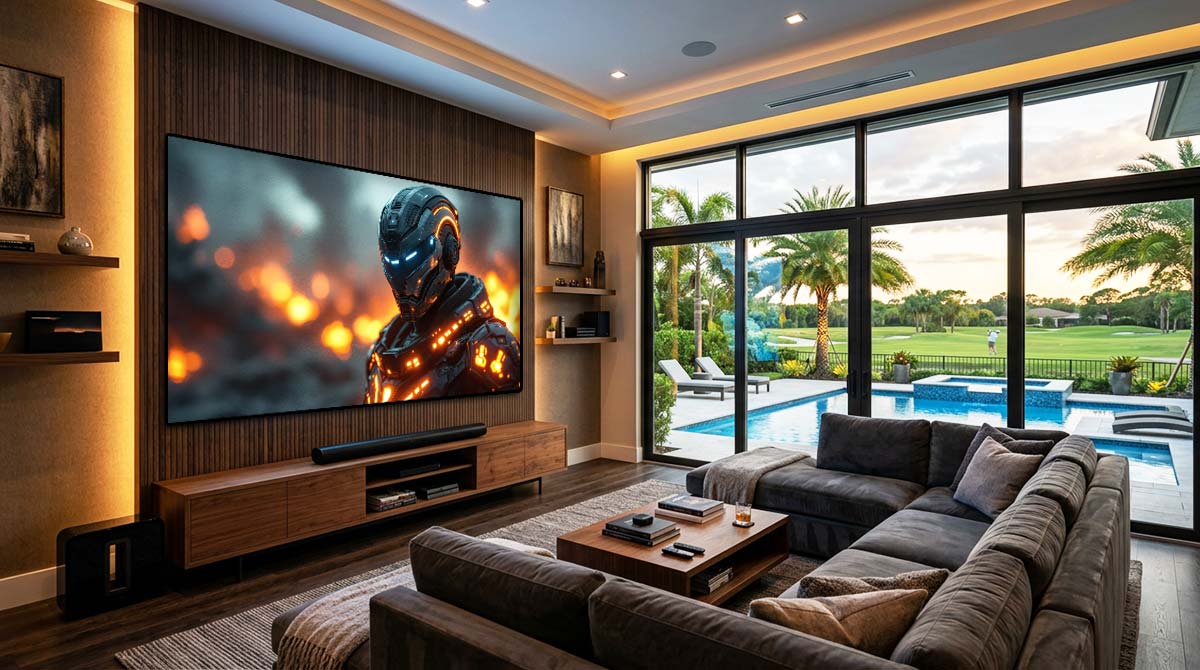
A luxury media room can incorporate a very large display or video wall, immersive audio, architectural speakers, motorized shades, sophisticated lighting control, hidden equipment, custom cabinetry, and whole-home automation.
That way, the technology is designed to coexist with the room’s multi-use purposes and everyday activities.
Common Retrofit Opportunities in Orlando Homes
Existing homes throughout the Orlando area present very different opportunities.
An enclosed bonus room in Windermere may be well-suited for a dedicated theater. A large great room overlooking the pool may be better suited to a media room. An underused secondary living area could potentially become either.
Instead of assuming that a particular room type automatically determines the answer, Definitive Electronics evaluates the existing conditions.
That is especially important in a retrofit.
A new custom home allows walls, wiring, HVAC, lighting, room dimensions, and equipment spaces to be engineered before construction even starts. An existing home requires a design that responds intelligently to what is already there.
The objective is to determine what should be preserved, what can be improved, and what is worth changing.
What Can Be Changed in an Existing Home?
Homeowners are sometimes surprised by what can be accomplished without rebuilding an entire room.
Depending on the home’s construction and the desired level of performance, a retrofit may include improvements to the display, speakers, lighting, shades, wiring, control, acoustics, seating, cabinetry, or equipment infrastructure.
For example, existing windows may be managed with motorized shading. Architectural speakers may be integrated into walls and ceilings. Lighting can be redesigned around entertainment scenes. Equipment can often be relocated so components are not visually prominent.
In a more extensive theater conversion, the project may also involve acoustic treatment, sound isolation, new wall or ceiling construction, HVAC modifications, risers, custom millwork, or specialty finishes.
The appropriate level of renovation depends on the room and your priorities.
Some homeowners want to preserve nearly everything about an existing space while substantially upgrading its entertainment capabilities. Others have an unused room and are comfortable with completely transforming it.
Both are valid starting points.
Not sure how much renovation your room actually needs? Definitive Electronics can assess the existing space before recommending displays, speakers, seating, or construction.
👉 Request an Orlando home entertainment consultation.
Windows, Natural Light, and Glare
Central Florida’s abundant sunlight makes light management particularly important.
The issue isn’t simply whether a room has windows. It’s how those windows affect the display, viewing conditions, and intended use of the space.
For a Dedicated Home Theater
A projection-based theater performs best with strong control over ambient light.
An existing room with few or no windows can therefore be an excellent candidate. Rooms with windows may still work, but the design may require blackout shading or other light-control strategies.
Motorized Lutron Shades can be integrated with the room’s lighting and control system so viewing conditions change automatically when a movie or entertainment scene begins.
For a Media Room
Natural light doesn’t necessarily need to disappear.
The goal is to manage glare and brightness while keeping the room connected to the rest of the home and, in many Orlando residences, to the outdoor living areas.
Motorized shades, lighting control, display selection, and careful screen placement can work together.
A room with large glass doors overlooking a pool or lanai, for example, may be an excellent media room candidate when the display is selected specifically for those lighting conditions.
Choosing the Right Display
One of the most common mistakes in an entertainment-room renovation is choosing the display first.
A homeowner sees an impressive projector, a 100-inch television, or a MicroLED wall and decides that it’s what the room needs.
The better approach is the reverse.
Evaluate the room first. Then select the display.
Laser Projection
Projection remains a compelling choice for dedicated home theaters because it can produce an exceptionally large image and cinematic presentation.
A high-performance laser projector paired with an acoustically transparent screen can also allow speakers to be positioned behind the image, helping dialogue and effects originate naturally from the screen area.
Projection, however, places demands on the existing room. Throw distance, screen location, ceiling height, ambient light, seating position, and projector placement all need to be considered.
Large-Format Televisions
Premium direct-view televisions are often ideal for media rooms.
Modern large-format displays provide excellent brightness, contrast, and color while performing well in rooms that cannot or should not be completely darkened.
They can also be incorporated into custom cabinetry or architectural features so the display feels intentional within the finished space.
MicroLED and Direct-View Video Walls
For homeowners seeking very large image sizes without projection, MicroLED and other premium direct-view video wall technologies create another option.
Their high brightness and modular sizing make them particularly attractive in rooms where ambient light or architectural conditions make projection difficult.
The investment can be substantial, but in the right project, a video wall can provide theater-like scale without many of the traditional limitations associated with projection.
Immersive Audio and Room Acoustics
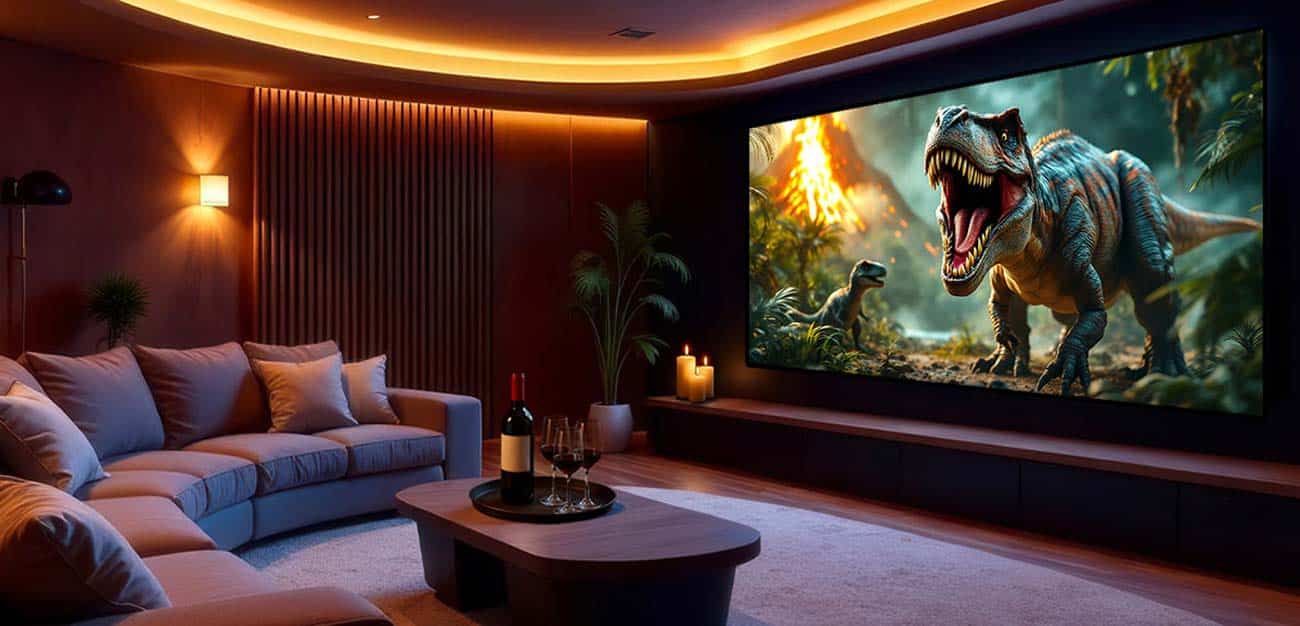
The visual experience gets much of the attention, but sound often determines whether a room merely looks impressive or actually feels immersive.
In a Dedicated Home Theater
A high-performance theater may address acoustics in two different ways.
The first is sound quality inside the room. Speaker positioning, subwoofer placement, room geometry, absorption, diffusion, bass management, and professional calibration can all influence what you hear.
The second is sound transmission outside the room.
If the theater is located near bedrooms, offices, or other living spaces, additional construction may be considered to reduce the amount of sound traveling through walls, ceilings, floors, and doors.
Dolby Atmos and other immersive formats can be particularly effective in a properly designed theater because speakers can be positioned around and above the seating to create a three-dimensional sound field.
In a Media Room
A media room typically doesn’t require the same level of dedicated acoustic construction.
That does not mean acoustics are unimportant.
Speaker placement, room dimensions, furnishings, reflective surfaces, calibration, and selective acoustic solutions can substantially affect performance.
Architectural in-wall and in-ceiling speakers can provide immersive sound while keeping the room visually clean. A well-designed media room can support Dolby Atmos and other sophisticated audio configurations without looking like a traditional theater.
Seating: Cinema or Conversation?
How people sit tells you a great deal about how the room will actually be used.
A dedicated theater usually orients seating toward the screen. Depending on room dimensions and the number of seats, that might mean one row of premium theater seating or multiple rows.
When multiple rows are appropriate, a well-engineered riser can improve sightlines and enhance the cinema experience.
A media room allows much more flexibility.
Sectionals, sofas, lounge chairs, ottomans, and custom seating can accommodate both viewing and conversation. The room may need to work equally well whether the display is the center of attention or not.
For an existing home, that distinction can be extremely useful.
Ask yourself: Do I want people to enter this room primarily to watch something, or do I want entertainment to be one of several things that happen here?
Lighting and Shading Can Transform the Experience
Lighting is often one of the most overlooked opportunities in an existing entertainment space.
A room doesn’t necessarily need architectural reconstruction to feel dramatically different.
Integrated lighting control can create dedicated scenes for:
- Movies
- Sports
- Gaming
- Entertaining
- Intermission
- Cleaning
- Everyday use
With Lutron lighting and motorized shades, a single command can lower shades, dim selected fixtures, preserve safe pathway lighting, and prepare the room for viewing.
When integrated with a broader Crestron, Control4, Savant, or other compatible control system, the room can become part of the home’s overall technology experience.
The objective is not automation for its own sake. It’s eliminating the sequence of switches, remotes, apps, and adjustments that would otherwise be necessary every time you use the room.
How Much Does It Cost to Retrofit a Media Room or Home Theater in Orlando?
There’s no meaningful single price for a luxury entertainment-room retrofit because existing conditions vary substantially.
The following costs should therefore be considered general planning ranges rather than quotes or fixed starting prices.
Media Room Retrofit Costs
Approximately $20,000–$50,000
A focused upgrade might include a premium large-format display, architectural audio, lighting or shade integration, equipment, control, installation, and programming.
Approximately $50,000–$100,000
Projects in this range may incorporate a larger premium display, more sophisticated immersive audio, custom cabinetry, motorized shading, advanced lighting control, seating, and broader home automation integration.
$100,000+
High-end media rooms may include MicroLED or other premium video walls, reference-level audio, bespoke millwork, sophisticated lighting and shading, and integration with whole-home AV and automation systems.
➡️ LEARN MORE: Home Video Systems, Big TVs, and Media Rooms in Orlando, Florida
Dedicated Home Theater Retrofit Costs
Approximately $50,000–$150,000
An existing room with favorable conditions may support a well-designed theater with laser projection or another premium display, immersive audio, lighting control, seating, and targeted acoustic improvements.
Approximately $150,000–$350,000
More extensive projects may incorporate sophisticated acoustic engineering, premium projection, multiple seating rows, custom acoustic treatments, lighting, control, millwork, and room renovations.
$350,000+
Reference-level theaters can include extensive acoustic architecture and isolation, premium seating, advanced projection or direct-view display technology, bespoke interiors, high-performance audio, and deep integration with the home’s technology systems.
➡️ LEARN MORE: Orlando Home Theater Design and Installation
Why Retrofit Costs Can Vary So Much
The AV equipment is only part of the investment.
An existing room may also require electrical work, wiring, framing, HVAC modifications, lighting, sound isolation, acoustic treatment, cabinetry, flooring, wall or ceiling work, and finish restoration.
Two rooms of identical size can therefore require very different investments.
This is another reason to evaluate the existing space before developing the equipment specification and budget.
How to Decide: Five Questions to Ask Before You Renovate
1. Is the room enclosed or connected to other living areas?
An enclosed room provides greater control over light and sound and may be a strong candidate for a home theater.
A great room, living room, or entertainment area connected to a kitchen, bar, or outdoor space generally favors a media-room approach.
2. How will you actually use the space?
If people will primarily enter the room to watch movies, sports, or other content together, a dedicated theater may be ideal.
If the room needs to support conversation, parties, games, casual television, music, and everyday family life, a media room provides greater flexibility.
3. How important is maximum audio and video performance?
A dedicated environment gives the designer greater control over acoustics, light, speaker positioning, viewing angles, and seating.
If maximizing performance is the priority, the additional renovation required to create a theater may be worthwhile.
If exceptional performance needs to coexist with everyday usability and architectural openness, a media room may be the better solution.
4. How much renovation are you comfortable undertaking?
One homeowner may want to upgrade a beautiful room without substantially altering its finishes.
Another may have an unused bonus room and say, “Take it down to the walls and make it extraordinary.”
Determine how much change you are comfortable with before deciding how ambitious the room should become.
5. What bothers you about the room today?
This question is often more revealing than asking what equipment you want.
Is the television too small?
Is dialogue difficult to understand?
Does afternoon glare make the screen difficult to see?
Are there too many remotes?
Does the room sound harsh?
Is equipment visible?
Do you want a much larger image?
Does everyone gather somewhere else because the room simply isn’t comfortable?
Solving those problems should guide the design.
Start with the Room, Not the Product Catalog
There is no universally “best” home theater projector, television, speaker system, seating arrangement, or automation platform for every Orlando home.
The best solution is the one designed around the existing architecture and the people who will use it.
That is particularly important with a retrofit.
A professional design process should begin by understanding the room, identifying limitations and opportunities, discussing how you want to use the space, and determining an appropriate level of renovation.
Only then should specific technologies be selected.
Designing Your Orlando Entertainment Space with Definitive Electronics
Definitive Electronics has been designing and installing home technology systems in Florida since 1999.
The team evaluates the room, your expectations, architectural considerations, and the level of renovation you are comfortable undertaking before developing recommendations.
That may lead to a dedicated cinema with immersive audio and carefully engineered acoustics. It could mean transforming a great room into a sophisticated media room with a large-format display, hidden architectural audio, motorized shades, and lighting control.
In some homes, the best solution may be something between the traditional definitions of a theater and media room.
The objective remains the same: create an entertainment space that belongs in your home, performs at the level you expect, and is enjoyable to use long after the installation is complete.
Ready to Re-Imagine an Existing Room?
If you have a bonus room, den, game room, great room, or other space you are considering upgrading, start with a professional evaluation before choosing the equipment.
👉 Schedule a VIP Consultation with Definitive Electronics to explore what is possible in your Orlando home.
Frequently Asked Questions
Can I turn an existing room into a home theater?
Yes. Bonus rooms, dens, bedrooms, game rooms, lofts, and other enclosed spaces can potentially be converted into dedicated home theaters. The room should first be evaluated for dimensions, ceiling height, windows, HVAC, wiring access, speaker placement, seating, and adjacent living areas. The goal is to design around the existing architecture rather than assume the room must meet a predetermined size or layout.
Do I need to completely gut a room to add a home theater?
Not necessarily. The amount of renovation depends on the existing room and the level of performance you want. Some projects can use much of the existing architecture while adding a display, speakers, lighting control, shades, seating, and targeted acoustic improvements. Reference-level theaters may require more extensive changes for sound isolation, acoustics, HVAC, wiring, or custom finishes.
Can I create a home theater in a room with windows?
Yes, although the windows need to be considered during the design process. Projection systems generally perform best when ambient light can be tightly controlled. Motorized blackout shades or other light-management strategies may make an existing room suitable for projection. A premium direct-view display may be another option when maintaining some ambient light is important.
Can a media room have Dolby Atmos?
Yes. A media room can incorporate Dolby Atmos using appropriately positioned speakers around and above the listening area. Architectural in-wall and in-ceiling speakers can provide immersive audio while minimizing visible technology. Room geometry and the open nature of some media rooms may affect the final speaker configuration.
Is a projector better than a large TV for an existing room?
Neither is automatically better. Projection can provide exceptional cinematic scale when the room offers sufficient light control, viewing distance, and appropriate placement. Large-format direct-view displays generally perform better in brighter multipurpose spaces and require less control over ambient light. The existing room should determine the display rather than the other way around.
Can Definitive Electronics upgrade an existing media room without replacing everything?
Potentially. An existing system should first be evaluated for compatibility, condition, performance, wiring, and the homeowner’s goals. In some cases, displays, speakers, control, lighting, shades, or other components can be upgraded selectively. In others, aging infrastructure or compatibility limitations may make a broader redesign the better long-term solution.
Can my new theater or media room integrate with the rest of my smart home?
Yes, compatible entertainment systems can be integrated with broader home control platforms. Depending on the system, a homeowner may be able to coordinate AV, lighting, motorized shades, climate, and other connected technologies through scenes and unified controls. Existing system compatibility should be evaluated before the project is specified.
How long does it take to retrofit a home theater or media room?
The timeline depends heavily on the scope. A targeted media-room upgrade may require considerably less time than a dedicated theater, which involves construction, acoustic work, custom millwork, HVAC modifications, lighting, or specialty finishes. A site evaluation allows the project team to identify those requirements before establishing a realistic schedule.
Should I call a home technology integrator before an interior designer or contractor?
For a technology-intensive entertainment renovation, involving the home technology integrator early can prevent conflicts involving display placement, speaker locations, wiring, lighting, HVAC, cabinetry, and equipment ventilation. For larger renovations, the integrator can coordinate with the homeowner, architect, interior designer, builder, and other trades to ensure technology requirements are incorporated into the overall design.
Our Growing Florida Service Areas
Definitive Electronics serves homeowners, builders, designers, and architects across many of Florida’s most distinguished communities, from South Florida’s coastline to Central Florida and the Gulf Coast, including:
Palm Beach County
Palm Beach, Boca Raton, Delray Beach, Jupiter, Jupiter Island, Manalapan, Boynton Beach, Wellington, Highland Beach, Palm Beach Gardens, West Palm Beach, and surrounding communities
Martin County
Stuart, Hobe Sound, Palm City, Sewall’s Point, Hutchinson Island, and nearby waterfront and golf communities
Broward County
Fort Lauderdale, Lighthouse Point, Weston, Coral Springs, Parkland, and coastal and nearby neighborhoods
Miami-Dade County
Miami, Miami Beach, Coral Gables, Key Biscayne, Bal Harbour, Aventura, Coconut Grove, and surrounding communities
Indian River County
Indian River Shores, Orchid, Sebastian, Vero Beach, Wabasso, Windsor
Orange County
Orlando, Windermere, Lake Nona, Winter Park, Isleworth, Keene’s Pointe, Golden Oak, and other Central Florida communities
Tampa Bay Area (Hillsborough and Pinellas Counties)
Tampa, St. Petersburg, Clearwater, Belleair, Palm Harbor, Tierra Verde, and surrounding residential areas
Oceanfront estates, canal properties, private golf communities, luxury condominiums, and new construction projects all benefit from integrated home technology solutions.
Wherever you are within our Florida Service Areas, Definitive Electronics is ready to bring thoughtful design, seamless control, and reliable performance into your space.
Like what you see? Share this post.
Table of Contents
Categories
Home Theater or Media Room: Which Is Right for Your Orlando Home?
You already have the house. Now you have a room that could be doing so much more.
Perhaps it’s an unused bonus room, den, game room, secondary living area, or formal space your family rarely uses. Or maybe your great room is where everyone gathers, but the existing television and audio system are just no longer good enough.
The question becomes: Should you turn the space into a dedicated home theater or create a high-performance media room?
The distinction matters. A home theater and a media room are not simply two versions of the same entertainment space at different price points. They serve different purposes and place different demands on the room.
This guide focuses primarily on existing Orlando homes and retrofit projects. Unlike designing a home theater for a new construction project, a retrofit begins with the architecture already in place. Room dimensions, windows, ceiling height, HVAC, wiring access, adjacent spaces, and the amount of renovation you are comfortable undertaking all help determine what makes sense for your entertainment goals.
The goal is not to force an existing room into a preconceived design. It’s about understanding what the space can support and creating the best entertainment experience for the way you and your family live.
Key Takeaways
- A dedicated home theater prioritizes cinematic immersion. Light control, immersive audio, acoustics, seating, and the display are designed around serious movie and entertainment viewing.
- A media room is designed for multiple uses. It may combine movies, sports, gaming, music, entertaining, and everyday family life in one comfortable space.
- Your existing room matters. Windows, dimensions, ceiling height, HVAC, adjacent rooms, and wiring access can influence which approach makes the most sense.
- A theater does not have to mean a projector. Projection remains an excellent choice, but premium direct-view displays and MicroLED can also be used in dedicated entertainment spaces.
- Retrofitting does not necessarily mean major construction. Some rooms can be transformed with relatively targeted improvements, while others justify a more extensive renovation.
- Start with the room, not the equipment. Display size, speakers, seating, lighting, shades, and control should be selected after the space and your goals have been evaluated.
Considering an entertainment upgrade in your Orlando home?
Definitive Electronics can evaluate your existing space and help determine whether a dedicated theater, media room, or another approach will deliver the experience you want.
👉 Schedule a private consultation.
Home Theater vs. Media Room: The Core Difference
A dedicated home theater is built primarily around the viewing experience.
The room is typically enclosed, with controlled lighting, carefully planned seating, immersive surround sound, and acoustics designed to support high-performance audio. Technology and architecture work together to create an environment where movies, concerts, sports, and other content take center stage.
A media room operates differently.
It is part entertainment space and part living space. You might watch a movie on Friday night, host friends for football on Sunday, play games with the family, stream a concert, or simply have music playing while everyone talks.
The technology can still be exceptional. It simply shares the room with other priorities.
| Feature | Dedicated Home Theater | Media Room |
|---|---|---|
| Primary purpose | Immersive viewing | Multipurpose entertainment |
| Room configuration | Usually enclosed | Enclosed, open, or semi-open |
| Light control | High level of control preferred | Ambient light can be managed |
| Display | Projection, large-format display, or direct-view LED | Large-format TV, video wall, or other direct-view display |
| Audio | Immersive surround with acoustic consideration | Architectural surround or immersive audio |
| Seating | Viewing-oriented, sometimes tiered | Sectionals, lounge seating, flexible arrangements |
| Acoustics | Often a major design priority | Integrated according to room and performance goals |
| Renovation | Can be more extensive | Often adaptable to existing architecture |
Neither approach is inherently better.
Ask yourself: Which experience makes the most sense for the room you already have?
Can Your Existing Room Become a Home Theater?
There’s no universal minimum room size that determines whether a space can become a home theater.
An unused bonus room, game room, den, bedroom, loft, or other enclosed space may be a candidate. What matters is how its dimensions and existing architecture affect the experience you want to create.
A professional evaluation should consider:
- Room width, length, and ceiling height
- Number of desired seats
- Viewing distance
- Screen size and location
- Speaker placement
- Windows and doors
- HVAC supply and return locations
- Noise from adjacent rooms
- Wiring access
- Equipment location
- Lighting
- Potential acoustic improvements
A larger room provides more flexibility for multiple seating rows, larger displays, speaker placement, circulation, and acoustic treatment. Smaller spaces can still produce impressive results when the system is designed around the room rather than forcing equipment into an unsuitable layout.
What About an Open Room?
An open great room or living area can deliver an extraordinary entertainment experience, but it’s generally better suited to a media room than to a traditional dedicated theater.
That doesn’t mean settling for a standard television and soundbar.
A luxury media room can incorporate a very large display or video wall, immersive audio, architectural speakers, motorized shades, sophisticated lighting control, hidden equipment, custom cabinetry, and whole-home automation.
That way, the technology is designed to coexist with the room’s multi-use purposes and everyday activities.
Common Retrofit Opportunities in Orlando Homes
Existing homes throughout the Orlando area present very different opportunities.
An enclosed bonus room in Windermere may be well-suited for a dedicated theater. A large great room overlooking the pool may be better suited to a media room. An underused secondary living area could potentially become either.
Instead of assuming that a particular room type automatically determines the answer, Definitive Electronics evaluates the existing conditions.
That is especially important in a retrofit.
A new custom home allows walls, wiring, HVAC, lighting, room dimensions, and equipment spaces to be engineered before construction even starts. An existing home requires a design that responds intelligently to what is already there.
The objective is to determine what should be preserved, what can be improved, and what is worth changing.
What Can Be Changed in an Existing Home?
Homeowners are sometimes surprised by what can be accomplished without rebuilding an entire room.
Depending on the home’s construction and the desired level of performance, a retrofit may include improvements to the display, speakers, lighting, shades, wiring, control, acoustics, seating, cabinetry, or equipment infrastructure.
For example, existing windows may be managed with motorized shading. Architectural speakers may be integrated into walls and ceilings. Lighting can be redesigned around entertainment scenes. Equipment can often be relocated so components are not visually prominent.
In a more extensive theater conversion, the project may also involve acoustic treatment, sound isolation, new wall or ceiling construction, HVAC modifications, risers, custom millwork, or specialty finishes.
The appropriate level of renovation depends on the room and your priorities.
Some homeowners want to preserve nearly everything about an existing space while substantially upgrading its entertainment capabilities. Others have an unused room and are comfortable with completely transforming it.
Both are valid starting points.
Not sure how much renovation your room actually needs? Definitive Electronics can assess the existing space before recommending displays, speakers, seating, or construction.
👉 Request an Orlando home entertainment consultation.
Windows, Natural Light, and Glare
Central Florida’s abundant sunlight makes light management particularly important.
The issue isn’t simply whether a room has windows. It’s how those windows affect the display, viewing conditions, and intended use of the space.
For a Dedicated Home Theater
A projection-based theater performs best with strong control over ambient light.
An existing room with few or no windows can therefore be an excellent candidate. Rooms with windows may still work, but the design may require blackout shading or other light-control strategies.
Motorized Lutron Shades can be integrated with the room’s lighting and control system so viewing conditions change automatically when a movie or entertainment scene begins.
For a Media Room
Natural light doesn’t necessarily need to disappear.
The goal is to manage glare and brightness while keeping the room connected to the rest of the home and, in many Orlando residences, to the outdoor living areas.
Motorized shades, lighting control, display selection, and careful screen placement can work together.
A room with large glass doors overlooking a pool or lanai, for example, may be an excellent media room candidate when the display is selected specifically for those lighting conditions.
Choosing the Right Display
One of the most common mistakes in an entertainment-room renovation is choosing the display first.
A homeowner sees an impressive projector, a 100-inch television, or a MicroLED wall and decides that it’s what the room needs.
The better approach is the reverse.
Evaluate the room first. Then select the display.
Laser Projection
Projection remains a compelling choice for dedicated home theaters because it can produce an exceptionally large image and cinematic presentation.
A high-performance laser projector paired with an acoustically transparent screen can also allow speakers to be positioned behind the image, helping dialogue and effects originate naturally from the screen area.
Projection, however, places demands on the existing room. Throw distance, screen location, ceiling height, ambient light, seating position, and projector placement all need to be considered.
Large-Format Televisions
Premium direct-view televisions are often ideal for media rooms.
Modern large-format displays provide excellent brightness, contrast, and color while performing well in rooms that cannot or should not be completely darkened.
They can also be incorporated into custom cabinetry or architectural features so the display feels intentional within the finished space.
MicroLED and Direct-View Video Walls
For homeowners seeking very large image sizes without projection, MicroLED and other premium direct-view video wall technologies create another option.
Their high brightness and modular sizing make them particularly attractive in rooms where ambient light or architectural conditions make projection difficult.
The investment can be substantial, but in the right project, a video wall can provide theater-like scale without many of the traditional limitations associated with projection.
Immersive Audio and Room Acoustics
The visual experience gets much of the attention, but sound often determines whether a room merely looks impressive or actually feels immersive.
In a Dedicated Home Theater
A high-performance theater may address acoustics in two different ways.
The first is sound quality inside the room. Speaker positioning, subwoofer placement, room geometry, absorption, diffusion, bass management, and professional calibration can all influence what you hear.
The second is sound transmission outside the room.
If the theater is located near bedrooms, offices, or other living spaces, additional construction may be considered to reduce the amount of sound traveling through walls, ceilings, floors, and doors.
Dolby Atmos and other immersive formats can be particularly effective in a properly designed theater because speakers can be positioned around and above the seating to create a three-dimensional sound field.
In a Media Room
A media room typically doesn’t require the same level of dedicated acoustic construction.
That does not mean acoustics are unimportant.
Speaker placement, room dimensions, furnishings, reflective surfaces, calibration, and selective acoustic solutions can substantially affect performance.
Architectural in-wall and in-ceiling speakers can provide immersive sound while keeping the room visually clean. A well-designed media room can support Dolby Atmos and other sophisticated audio configurations without looking like a traditional theater.
Seating: Cinema or Conversation?
How people sit tells you a great deal about how the room will actually be used.
A dedicated theater usually orients seating toward the screen. Depending on room dimensions and the number of seats, that might mean one row of premium theater seating or multiple rows.
When multiple rows are appropriate, a well-engineered riser can improve sightlines and enhance the cinema experience.
A media room allows much more flexibility.
Sectionals, sofas, lounge chairs, ottomans, and custom seating can accommodate both viewing and conversation. The room may need to work equally well whether the display is the center of attention or not.
For an existing home, that distinction can be extremely useful.
Ask yourself: Do I want people to enter this room primarily to watch something, or do I want entertainment to be one of several things that happen here?
Lighting and Shading Can Transform the Experience
Lighting is often one of the most overlooked opportunities in an existing entertainment space.
A room doesn’t necessarily need architectural reconstruction to feel dramatically different.
Integrated lighting control can create dedicated scenes for:
- Movies
- Sports
- Gaming
- Entertaining
- Intermission
- Cleaning
- Everyday use
With Lutron lighting and motorized shades, a single command can lower shades, dim selected fixtures, preserve safe pathway lighting, and prepare the room for viewing.
When integrated with a broader Crestron, Control4, Savant, or other compatible control system, the room can become part of the home’s overall technology experience.
The objective is not automation for its own sake. It’s eliminating the sequence of switches, remotes, apps, and adjustments that would otherwise be necessary every time you use the room.
How Much Does It Cost to Retrofit a Media Room or Home Theater in Orlando?
There’s no meaningful single price for a luxury entertainment-room retrofit because existing conditions vary substantially.
The following costs should therefore be considered general planning ranges rather than quotes or fixed starting prices.
Media Room Retrofit Costs
Approximately $20,000–$50,000
A focused upgrade might include a premium large-format display, architectural audio, lighting or shade integration, equipment, control, installation, and programming.
Approximately $50,000–$100,000
Projects in this range may incorporate a larger premium display, more sophisticated immersive audio, custom cabinetry, motorized shading, advanced lighting control, seating, and broader home automation integration.
$100,000+
High-end media rooms may include MicroLED or other premium video walls, reference-level audio, bespoke millwork, sophisticated lighting and shading, and integration with whole-home AV and automation systems.
➡️ LEARN MORE: Home Video Systems, Big TVs, and Media Rooms in Orlando, Florida
Dedicated Home Theater Retrofit Costs
Approximately $50,000–$150,000
An existing room with favorable conditions may support a well-designed theater with laser projection or another premium display, immersive audio, lighting control, seating, and targeted acoustic improvements.
Approximately $150,000–$350,000
More extensive projects may incorporate sophisticated acoustic engineering, premium projection, multiple seating rows, custom acoustic treatments, lighting, control, millwork, and room renovations.
$350,000+
Reference-level theaters can include extensive acoustic architecture and isolation, premium seating, advanced projection or direct-view display technology, bespoke interiors, high-performance audio, and deep integration with the home’s technology systems.
➡️ LEARN MORE: Orlando Home Theater Design and Installation
Why Retrofit Costs Can Vary So Much
The AV equipment is only part of the investment.
An existing room may also require electrical work, wiring, framing, HVAC modifications, lighting, sound isolation, acoustic treatment, cabinetry, flooring, wall or ceiling work, and finish restoration.
Two rooms of identical size can therefore require very different investments.
This is another reason to evaluate the existing space before developing the equipment specification and budget.
How to Decide: Five Questions to Ask Before You Renovate
1. Is the room enclosed or connected to other living areas?
An enclosed room provides greater control over light and sound and may be a strong candidate for a home theater.
A great room, living room, or entertainment area connected to a kitchen, bar, or outdoor space generally favors a media-room approach.
2. How will you actually use the space?
If people will primarily enter the room to watch movies, sports, or other content together, a dedicated theater may be ideal.
If the room needs to support conversation, parties, games, casual television, music, and everyday family life, a media room provides greater flexibility.
3. How important is maximum audio and video performance?
A dedicated environment gives the designer greater control over acoustics, light, speaker positioning, viewing angles, and seating.
If maximizing performance is the priority, the additional renovation required to create a theater may be worthwhile.
If exceptional performance needs to coexist with everyday usability and architectural openness, a media room may be the better solution.
4. How much renovation are you comfortable undertaking?
One homeowner may want to upgrade a beautiful room without substantially altering its finishes.
Another may have an unused bonus room and say, “Take it down to the walls and make it extraordinary.”
Determine how much change you are comfortable with before deciding how ambitious the room should become.
5. What bothers you about the room today?
This question is often more revealing than asking what equipment you want.
Is the television too small?
Is dialogue difficult to understand?
Does afternoon glare make the screen difficult to see?
Are there too many remotes?
Does the room sound harsh?
Is equipment visible?
Do you want a much larger image?
Does everyone gather somewhere else because the room simply isn’t comfortable?
Solving those problems should guide the design.
Start with the Room, Not the Product Catalog
There is no universally “best” home theater projector, television, speaker system, seating arrangement, or automation platform for every Orlando home.
The best solution is the one designed around the existing architecture and the people who will use it.
That is particularly important with a retrofit.
A professional design process should begin by understanding the room, identifying limitations and opportunities, discussing how you want to use the space, and determining an appropriate level of renovation.
Only then should specific technologies be selected.
Designing Your Orlando Entertainment Space with Definitive Electronics
Definitive Electronics has been designing and installing home technology systems in Florida since 1999.
The team evaluates the room, your expectations, architectural considerations, and the level of renovation you are comfortable undertaking before developing recommendations.
That may lead to a dedicated cinema with immersive audio and carefully engineered acoustics. It could mean transforming a great room into a sophisticated media room with a large-format display, hidden architectural audio, motorized shades, and lighting control.
In some homes, the best solution may be something between the traditional definitions of a theater and media room.
The objective remains the same: create an entertainment space that belongs in your home, performs at the level you expect, and is enjoyable to use long after the installation is complete.
Ready to Re-Imagine an Existing Room?
If you have a bonus room, den, game room, great room, or other space you are considering upgrading, start with a professional evaluation before choosing the equipment.
👉 Schedule a VIP Consultation with Definitive Electronics to explore what is possible in your Orlando home.
Frequently Asked Questions
Can I turn an existing room into a home theater?
Yes. Bonus rooms, dens, bedrooms, game rooms, lofts, and other enclosed spaces can potentially be converted into dedicated home theaters. The room should first be evaluated for dimensions, ceiling height, windows, HVAC, wiring access, speaker placement, seating, and adjacent living areas. The goal is to design around the existing architecture rather than assume the room must meet a predetermined size or layout.
Do I need to completely gut a room to add a home theater?
Not necessarily. The amount of renovation depends on the existing room and the level of performance you want. Some projects can use much of the existing architecture while adding a display, speakers, lighting control, shades, seating, and targeted acoustic improvements. Reference-level theaters may require more extensive changes for sound isolation, acoustics, HVAC, wiring, or custom finishes.
Can I create a home theater in a room with windows?
Yes, although the windows need to be considered during the design process. Projection systems generally perform best when ambient light can be tightly controlled. Motorized blackout shades or other light-management strategies may make an existing room suitable for projection. A premium direct-view display may be another option when maintaining some ambient light is important.
Can a media room have Dolby Atmos?
Yes. A media room can incorporate Dolby Atmos using appropriately positioned speakers around and above the listening area. Architectural in-wall and in-ceiling speakers can provide immersive audio while minimizing visible technology. Room geometry and the open nature of some media rooms may affect the final speaker configuration.
Is a projector better than a large TV for an existing room?
Neither is automatically better. Projection can provide exceptional cinematic scale when the room offers sufficient light control, viewing distance, and appropriate placement. Large-format direct-view displays generally perform better in brighter multipurpose spaces and require less control over ambient light. The existing room should determine the display rather than the other way around.
Can Definitive Electronics upgrade an existing media room without replacing everything?
Potentially. An existing system should first be evaluated for compatibility, condition, performance, wiring, and the homeowner’s goals. In some cases, displays, speakers, control, lighting, shades, or other components can be upgraded selectively. In others, aging infrastructure or compatibility limitations may make a broader redesign the better long-term solution.
Can my new theater or media room integrate with the rest of my smart home?
Yes, compatible entertainment systems can be integrated with broader home control platforms. Depending on the system, a homeowner may be able to coordinate AV, lighting, motorized shades, climate, and other connected technologies through scenes and unified controls. Existing system compatibility should be evaluated before the project is specified.
How long does it take to retrofit a home theater or media room?
The timeline depends heavily on the scope. A targeted media-room upgrade may require considerably less time than a dedicated theater, which involves construction, acoustic work, custom millwork, HVAC modifications, lighting, or specialty finishes. A site evaluation allows the project team to identify those requirements before establishing a realistic schedule.
Should I call a home technology integrator before an interior designer or contractor?
For a technology-intensive entertainment renovation, involving the home technology integrator early can prevent conflicts involving display placement, speaker locations, wiring, lighting, HVAC, cabinetry, and equipment ventilation. For larger renovations, the integrator can coordinate with the homeowner, architect, interior designer, builder, and other trades to ensure technology requirements are incorporated into the overall design.
Our Growing Florida Service Areas
Definitive Electronics serves homeowners, builders, designers, and architects across many of Florida’s most distinguished communities, from South Florida’s coastline to Central Florida and the Gulf Coast, including:
Palm Beach County
Palm Beach, Boca Raton, Delray Beach, Jupiter, Jupiter Island, Manalapan, Boynton Beach, Wellington, Highland Beach, Palm Beach Gardens, West Palm Beach, and surrounding communities
Martin County
Stuart, Hobe Sound, Palm City, Sewall’s Point, Hutchinson Island, and nearby waterfront and golf communities
Broward County
Fort Lauderdale, Lighthouse Point, Weston, Coral Springs, Parkland, and coastal and nearby neighborhoods
Miami-Dade County
Miami, Miami Beach, Coral Gables, Key Biscayne, Bal Harbour, Aventura, Coconut Grove, and surrounding communities
Indian River County
Indian River Shores, Orchid, Sebastian, Vero Beach, Wabasso, Windsor
Orange County
Orlando, Windermere, Lake Nona, Winter Park, Isleworth, Keene’s Pointe, Golden Oak, and other Central Florida communities
Tampa Bay Area (Hillsborough and Pinellas Counties)
Tampa, St. Petersburg, Clearwater, Belleair, Palm Harbor, Tierra Verde, and surrounding residential areas
Oceanfront estates, canal properties, private golf communities, luxury condominiums, and new construction projects all benefit from integrated home technology solutions.
Wherever you are within our Florida Service Areas, Definitive Electronics is ready to bring thoughtful design, seamless control, and reliable performance into your space.